
Ayurvedic Stream
Ancient wisdom meets modern science — Ayurvedic is India's 5,000-year-old system of holistic medicine, recognised globally as a comprehensive healthcare system. BAMS graduates practice, research, and integrate classical Ayurvedic healing with contemporary medical knowledge to address India's growing demand for natural healthcare.
Overview
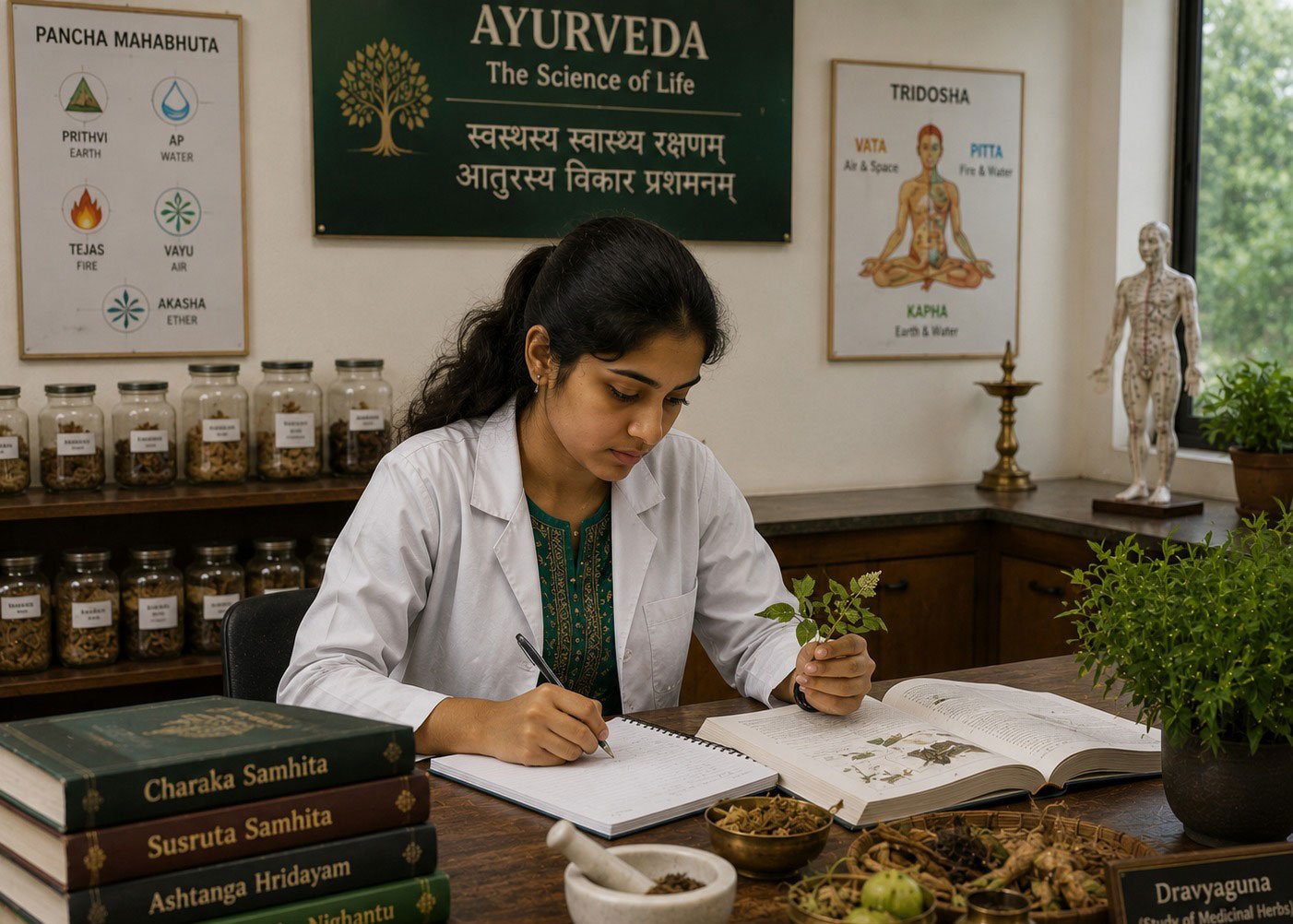
Ayurvedic is India's ancient system of holistic medicine — a 5,000-year-old science of life that is now recognised by the World Health Organisation (WHO) as a comprehensive Traditional System of Medicine. It is not merely a set of remedies but a complete philosophy of health, disease prevention, and longevity based on the balance of the three doshas — Vata, Pitta, and Kapha.
The Ayurvedic stream in India leads to the BAMS (Bachelor of Ayurvedic Medicine and Surgery) degree — a 5½-year undergraduate programme including a 1-year compulsory internship. BAMS graduates are licensed medical practitioners who can independently diagnose, prescribe, and treat patients using classical Ayurvedic medicine, herbal therapies, Panchakarma, and Shalya Tantra (Ayurvedic surgery).
India has over 3,500 Ayurvedic colleges, 7.5 lakh registered Ayurvedic practitioners, and a rapidly growing herbal medicine industry worth ₹50,000 crore. With PM Modi's dedicated Ministry of AYUSH, Ayurvedic has unprecedented government support — from National AYUSH Mission funding to international Ayurvedic promotion through India's foreign missions.
Postgraduate programs include MD Ayurvedic (specialisations in Kayachikitsa, Panchakarma, Shalakya Tantra, etc.), PhD in Ayurvedic, and interdisciplinary programs like MBA Hospital Management for Ayurvedic hospital administration.
Ayurvedic offers a diverse range of career pathways — from clinical practice and research to wellness entrepreneurship, the booming herbal products industry, and international health diplomacy. With India's AYUSH sector receiving ₹3,712 crore in Union Budget 2025-26, opportunities for Ayurvedic graduates have never been greater.
BAMS builds a rigorous foundation in classical Ayurvedic medical science alongside modern biomedical knowledge — equipping graduates to practise holistic medicine, conduct research, manage wellness enterprises, and contribute to India's growing herbal health economy.
India's AYUSH sector is undergoing a major transformation with government investment, scientific validation, and global wellness tourism driving rapid growth. The global Ayurvedic market is projected to reach $14.9 billion by 2030, growing at 16% annually.
CCRAS (Central Council for Research in Ayurvedic Sciences) is funding clinical trials validating Ayurvedic treatments for diabetes, arthritis, psoriasis, and metabolic disorders. CSIR's mission on traditional medicine and ICMR-CCRAS joint studies are producing high-impact publications in international journals. BAMS graduates with research aptitude can join CCRAS, NIMR, AIIA, or university research departments for impactful scientific careers.
India's herbal medicine market is worth ₹50,000 crore and growing at 15% annually. Companies like Dabur, Himalaya, Patanjali, Baidyanath, and Zandu collectively employ thousands of Ayurvedic professionals for product R&D, quality control, and regulatory affairs. The global natural products market exceeds $200 billion — Indian herbal exports reached ₹8,000 crore in 2024, creating massive demand for Ayurvedic professionals with pharma industry skills.
India received 10 million+ wellness tourists in 2025 — Kerala, Uttarakhand, Rajasthan, and Goa are premier global destinations for authentic Ayurvedic healing experiences. Luxury Ayurvedic resorts such as Ananda in the Himalayas, Kairali, Somatheeram, and The Leela operate dedicated Panchakarma programmes managed by resident Ayurvedic physicians. International wellness centres in Germany, USA, Sri Lanka, and UAE are actively recruiting experienced Ayurvedic doctors for long-term postings.
Telemedicine in AYUSH has grown 400% post-COVID. Platforms like Nirog Street, Jiva Ayurvedic, Kerala Ayurvedic, and Vedix are building AI-driven Ayurvedic consultation, personalised herbal product recommendation, and Prakriti analysis apps. BAMS graduates with digital health skills can join or found Ayurvedic health-tech startups — an emerging sector receiving significant venture capital investment from India's health-tech ecosystem.
Ayurgenomics — the science correlating Ayurvedic Prakriti (body constitution) with genetic profiles, disease susceptibility, and drug metabolism — is an exciting frontier being pioneered by CSIR-IGIB New Delhi. Integrative medicine combining Ayurvedic with modern diagnostics (functional MRI, genomics, metabolomics) is gaining acceptance in cancer care, autoimmune diseases, and neurological disorders at top Indian and international institutions.
India's Ministry of External Affairs actively promotes Ayurvedic through AYUSH chairs at foreign universities. WHO's Traditional Medicine Strategy 2025-2034 has strengthened Ayurvedic's global credibility. BAMS graduates can work as Ayurvedic physicians in Germany (permitted as Heilpraktiker), UK, USA, Canada, Sri Lanka, Mauritius, and UAE — with growing demand from Indian diaspora communities and international wellness seekers seeking authentic Indian medicine.
All AIIMS (All India Institute of Medical Sciences) are now integrating AYUSH wings — AIIMS Delhi, Rishikesh, and Jodhpur have functional Ayurvedic OPDs managed by BAMS/MD Ayu doctors. State governments are opening new 50–200 bed AYUSH hospitals across India. The National AYUSH Mission has allocated ₹3,712 crore for 2025-26 — creating thousands of Medical Officer (AYUSH) posts in government hospitals across every state.
With 90% of India's 7,500 medicinal plants currently wild-harvested and increasingly threatened, cultivated medicinal plants are the future of sustainable Ayurvedic. BAMS graduates with agri-herbal knowledge can establish medicinal plant farms, contract farming networks for pharma companies, or aromatic plant distilleries (essential oils for Ayurvedic and cosmetics). NABARD provides up to ₹2 crore loans for medicinal plant cultivation ventures under the National Medicinal Plant Board (NMPB) subsidy scheme.
BAMS is the foundational Ayurvedic medical degree — a 4½-year programme plus 1-year compulsory rotatory internship, totalling 5½ years. MD Ayurvedic is the prestigious 3-year postgraduate specialisation that opens the highest clinical, research, and academic career pathways.
BAMS admission in India is governed by NEET UG — the same national entrance exam used for MBBS and BDS. This makes Ayurvedic an excellent career choice for NEET qualifiers who want a medical degree with strong government job opportunities and entrepreneurship potential.
NEET UG is the sole entrance for BAMS — the same exam as MBBS. A competitive NEET score (typically 400+ for government Ayurvedic colleges) is essential. Planning your NEET preparation specifically for Biology ensures the best Ayurvedic college placement in India.
Conducted by NTA (National Testing Agency), NEET UG is India's only medical entrance examination for BAMS, MBBS, BDS, BUMS, and BHMS. BAMS aspirants compete in the same pool as MBBS aspirants — a single merit list determines allocation to Ayurvedic and Allopathic colleges based on preferences and score.
The All India AYUSH Post Graduate Entrance Test (AIAPGET), conducted by NTA, is the gateway to MD/MS Ayurvedic at all government and private Ayurvedic medical colleges across India — the equivalent of NEET PG for Ayurvedic. Top AIAPGET rank holders secure seats at IPGT&RA Jamnagar and BHU.
After NEET UG results, each state's AYUSH Admission Board / DMER conducts separate counselling for 85% state quota BAMS seats at government and private Ayurvedic colleges — offering significant domicile advantages with lower effective cut-offs for state residents compared to AIQ competition.
For BAMS graduates aspiring to a research career, CCRAS JRF (Central Council for Research in Ayurvedic Sciences Junior Research Fellowship) and CSIR-UGC NET for Life Sciences are the key funding mechanisms for PhD-level research in Ayurvedic pharmacology, clinical research, and herbal drug development.
Ayurvedic salaries in India are growing rapidly with government AYUSH expansion and the booming wellness industry. Entrepreneurial BAMS graduates establishing successful clinics, Panchakarma centres, or wellness resorts often earn far more than salaried positions — especially in Kerala, Bengaluru, Pune, and metro cities.
BAMS graduates are employed across India's complete Ayurvedic ecosystem — from government AYUSH hospitals and CCRAS research institutes to herbal pharma giants, luxury wellness resorts, and global Ayurvedic organisations. No traditional medical system in India has wider employment breadth than Ayurvedic.
Faculty of Ayurvedic, IMS BHU Varanasi leads the government rankings — one of India's oldest and most prestigious Ayurvedic institutions. Among private colleges, Amrita School of Ayurvedic Kollam, SDM College Udupi, and Vaidyaratnam Ayurvedic College Thrissur are the most respected institutions nationally.