
"Education is not the learning of facts, but the training of the mind to think." — Often attributed to Albert Einstein. Every parent dreams of seeing their child succeed. They want their son or daughter to become a doctor, engineer, scientist, entrepreneur, artist, civil servant, or any professional who enjoys a fulfilling life. Schools also claim to prepare children for a brighter future. Governments introduce new policies, education boards revise syllabi, and coaching institutes promise guaranteed success.
But amid all these ambitions, one fundamental question often goes unanswered: are we preparing children for life, or are we preparing them only for examinations?
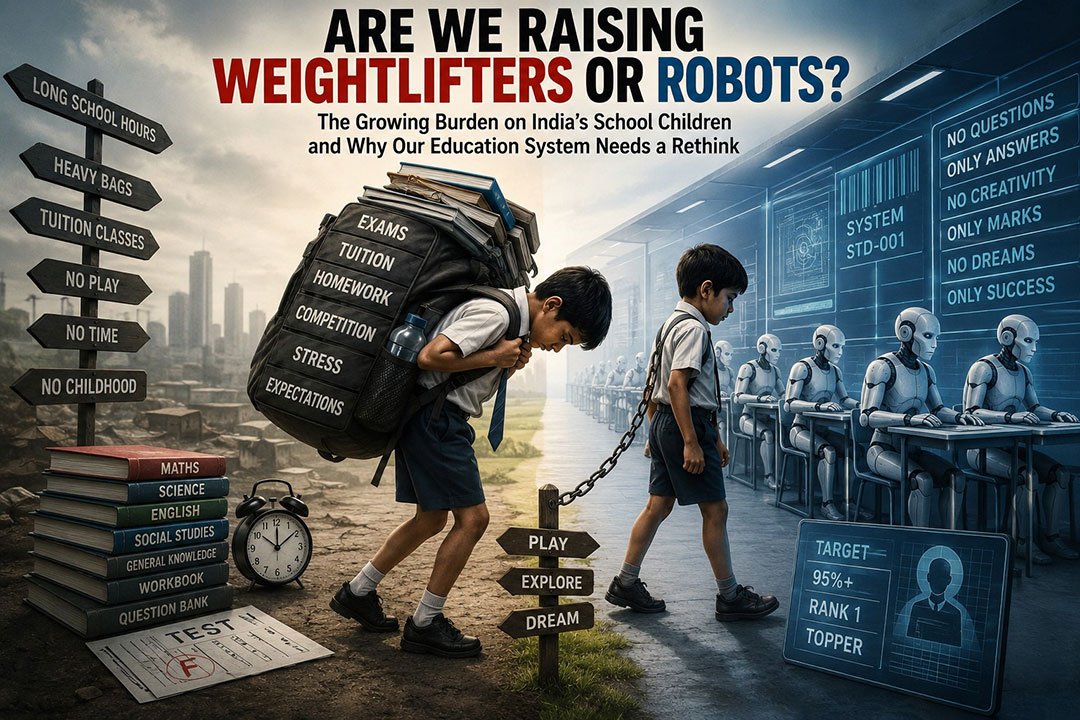
Take a walk outside any school in India during the morning hours. You will witness a familiar scene. Tiny children, some only five or six years old, struggle to walk while carrying oversized school bags. Their shoulders bend under the weight of textbooks, notebooks, lunch boxes, water bottles, art materials, activity books, and sports uniforms. Many climb several flights of stairs before reaching their classrooms — already exhausted before the first bell.
After six to eight hours in school, many students attend tuition classes. Once home, they spend another two to four hours on homework, projects, and test preparation. Weekends, which once belonged to playgrounds and family outings, are increasingly occupied by coaching classes, Olympiad preparation, coding lessons, and skill-development programmes.
The Weight of the School Bag — In Numbers
Researchers generally agree a child's school bag should stay within about 10% of body weight. Across India, study after study finds the real number runs much higher — and CampusNewz pulled together the data.
Avg. Bag Weight, Bangalore Study
13.5% of body wt.500 schoolchildren aged 12–15; average bag = 6.53 kg, well above the recommended cap.
Govt. Recommended Limit
10% of body wt.Ministry of Education's Policy on School Bag 2020, based on NCERT survey data.
Boys Exceeding the Limit
81%Same Bangalore study; 86% of girls in the sample also exceeded the 10% threshold.
Historic Extreme
30–40% of body wt.A 2003 review found some schoolchildren carrying this much before ergonomic limits took hold.
Sources: cross-sectional backpack-weight study, Bangalore (NCBI, 2024); "The Impact of Backpack Loads on School Children" narrative review (NCBI); Ministry of Education, Policy on School Bag 2020.
What the Policy Actually Says
The 2020 policy — drawn from NCERT surveys of over 3,600 students and nearly 3,000 parents across 352 schools — set class-wise bag-weight ranges and capped homework for younger children.
| Class | Suggested bag weight | Homework |
|---|---|---|
| Pre-primary | No bags | None |
| I – II | 1.6 – 2.2 kg | None |
| III – V | 1.7 – 3.0 kg | Max. 2 hrs / week |
| VI – VIII | 2.5 – 4.5 kg | Max. 1 hr / day |
| IX – XII | 3.5 – 5.0 kg | Max. 2 hrs / day |
Medical experts have repeatedly warned that excessively heavy school bags can contribute to poor posture, shoulder pain, neck strain, and — over years — spinal problems, since a young child's skeletal system is still developing. The physical burden is accompanied by a psychological one: each notebook another assignment, each textbook another chapter to memorise, each exam another layer of pressure.
The Pressure Begins Too Early
It is astonishing how academic competition now begins before children even understand its purpose. Admissions into reputed schools involve interviews. Children attend preschool coaching. Parents compare report cards. Students prepare for Olympiads while still in primary school. Private tuition has become common even for Class 1 students. The message children receive is simple: marks matter, ranks matter, competition matters.
But what about curiosity? What about kindness, confidence, happiness? These qualities rarely appear on report cards, yet they determine success throughout life.
Are We Teaching Children or Training Them?
There is a difference between education and training. Training prepares people to perform specific tasks; education prepares people to think. When classrooms focus entirely on memorisation, repetitive homework, and examination technique, children gradually become conditioned to search only for the "correct answer." Real life rarely works this way — it presents uncertainty, requires creativity, collaboration, and emotional intelligence, none of which can be built from textbooks alone.
The Coaching Culture — By the Numbers
India's coaching sector has grown from an after-school supplement into a parallel education system, and one of the country's fastest-growing industries.
Coaching Market, 2021
₹58,089 CrInfinium Global Research estimate for India's coaching classes market.
Projected Market, 2028
₹1,33,995 Cr13% projected annual growth; other trackers estimate $17–18B by the early 2030s.
JEE Aspirants vs. IIT+NIT Seats
~1.2M vs ~24KRecent-year estimates reported via industry trackers (India Today / IMARC).
NEET Aspirants vs. MBBS Seats
~2.3M vs ~1.09LSame source; illustrates the scale of competition driving demand for coaching.
Sources: Infinium Global Research, India Coaching Classes Market (2021–2028); IMARC Group, India Coaching Institutes Market (2024–2034); BW Education, "Inside India's Rs 50,000 Cr Coaching Industry."
While coaching undoubtedly helps many students achieve their goals, it has also created a culture where learning is increasingly replaced by exam preparation — a mindset that limits creativity and independent thinking, and starts earlier every year.
The Hour-by-Hour Squeeze
Add up school, homework, coaching and self-study, and the average Indian student's day looks less like childhood and more like a full-time job — before screens or sleep even enter the picture. The exact number varies by age and by whether a student attends coaching, but the pattern is consistent.
| Stage | School | Homework | Coaching/Tuition | Self-study | Total/day |
|---|---|---|---|---|---|
| Primary (I–V) | 6–7 hrs | 1–2 hrs | 0–1 hr | 30 min–1 hr | 7–9 hrs |
| Middle (VI–VIII) | 6–7 hrs | 2 hrs | 1–2 hrs | 1 hr | 8–10 hrs |
| Secondary (IX–X) | 6–7 hrs | 2–3 hrs | 2–3 hrs | 1–2 hrs | 10–12 hrs |
| Sr. Secondary (XI–XII / JEE-NEET) | 6–7 hrs | 2–3 hrs | 3–6 hrs | 2–5 hrs | 12–16 hrs |
For competitive-exam aspirants in Classes 11 and 12, 12–16 hours a day of combined academic work is common during peak preparation, according to coaching schedules and student surveys — leaving under an hour, most days, for anything else.
Time Spent on TV, Mobile & Gaming
Recent nationwide surveys show recreational screen use remains high alongside this academic load. The National Council of CBSE Schools (2026) found that 74% of students spend more than two hours a day on screens for non-academic purposes, and 21% spend over four hours a day on phones, gaming and social media. Separate research on Indian school students put average screen time at 3 hours 35 minutes a day, with some students reaching as much as 8.5 hours.
Students on 2+ hrs recreational screens/day
74%National Council of CBSE Schools survey (2026).
Students on 4+ hrs of phones/gaming/social
21%Same 2026 CBSE-schools survey.
Average daily screen time
3 hrs 35 minResearch on Indian school students; some students reached 8.5 hrs/day.
Teachers reporting less outdoor play
66%NCCS survey of teachers, 2026.
Health Issues School Students Are Facing
Stack a 10–16 hour academic day on top of several more hours of screen time, and the health effects show up in fairly predictable places — attention, sleep, eyesight, posture, and mood.
Mental Health
According to teachers surveyed in the NCCS study: 69% report reduced attention span in the classroom, 63% observe anxiety, irritability and emotional stress among students, and 66% report a decline in outdoor activity and face-to-face interaction.
Eye Problems
Indian research on school students found 27% reporting dry eyes and 10% reporting headaches linked to screen use. Higher screen time is associated with poorer academic performance, and longer exposure also correlates with sleep problems and neck pain. Separately, large international analyses link every additional hour of daily screen time with a higher risk of developing myopia (short-sightedness).
Sleep Problems
Studies consistently associate excessive screen use with poor sleep quality, late-night phone use, difficulty concentrating the next day, and increased daytime fatigue — compounding a day that, for board-exam students, already runs on just 6–7 hours of sleep, below the 8–10 hours recommended for adolescents.
Obesity & Physical Fitness
Reduced outdoor activity contributes to childhood obesity, poor posture, reduced cardiovascular fitness, and a higher future risk of diabetes and hypertension.
Neck & Back Pain
Doctors increasingly report "text neck," shoulder pain and back pain among school students — poor posture built up from long hours sitting in classrooms, coaching centres, and in front of devices.
Emotional & Behavioural Problems
A large review covering more than 292,000 children found higher screen time linked with anxiety, depression, aggression, and lower self-esteem. The relationship appears to run both ways: children already experiencing emotional difficulties may also turn to screens more often.
Teachers: reduced attention span
69%NCCS teacher survey, 2026.
Teachers: anxiety/irritability observed
63%Same survey; behavioural changes noted alongside emotional stress.
Students reporting dry eyes
27%Indian research on screen exposure among school students.
Students reporting headaches
10%Same research; linked to screen use.
The Bigger Picture
Many Indian students today spend 10–14 hours in academic work (school, homework, coaching and self-study combined), 2–4 hours on recreational screens, less than one hour playing outdoors, and 6–7 hours asleep — below the 8–10 hours recommended for adolescents. This combination of academic pressure, reduced physical activity and high screen exposure is associated with declining attention, sleep problems, stress, eye strain, and reduced overall wellbeing.
Sources: National Council of CBSE Schools student time-use and screen-time survey (2026); Indian research on screen time, sleep and eye strain among school students; international review of screen time and child mental health (n≈292,000); international analyses linking screen time with myopia risk.
What Can We Learn from Other Countries?
Several countries have adopted very different approaches to education — none perfect, but each showing that academic success does not require overwhelming children with homework, heavy bags, or constant testing. See "Lessons from Abroad" in the sidebar for how Finland, Japan and Singapore compare.
Parents Also Share Responsibility
Parents naturally want the best for their children. However, love sometimes transforms into unrealistic expectations. Many compare their children with neighbours, marks, or schools, and enrol children in multiple coaching classes without considering whether the child truly needs them. Every child develops differently — some excel in mathematics, some are gifted artists, others become excellent athletes or leaders. No single examination can measure every talent.
Schools Must Become Learning Communities
Schools should not simply produce high examination scores — they should produce thoughtful citizens. Teachers should be empowered to encourage discussion rather than merely complete the syllabus. Homework should reinforce learning instead of consuming childhood. Sports, music, theatre, debate, coding, environmental awareness, financial literacy, and emotional intelligence should receive equal importance. Education should prepare students for life — not merely for examinations.
Researchers who study India's exam culture have flagged a serious, connected concern: rising academic stress among students preparing for high-stakes exams, including competitive entrance tests. Public-health literature notes that India's youth suicide rate is among the highest in the world, with exam-linked stress a recurring factor identified by researchers in several states — a reminder that the costs of this system go well beyond backpacks and homework hours.
Redefining Success
Society often celebrates only a few professions — doctors, engineers, civil servants, corporate executives. Yet every profession contributes to nation-building: teachers educate future generations, farmers feed the country, artists preserve culture, entrepreneurs create jobs, journalists inform society. Success cannot be measured only by salary packages. A truly educated person demonstrates honesty, empathy, responsibility, critical thinking, and respect for others — qualities that deserve equal recognition.
A Better Way Forward
Educational reform should focus on balance: school bags within recommended weight limits, curricula that emphasise understanding over memorisation, homework that is meaningful rather than excessive, and technology that complements teachers rather than replacing them. Assessment should value creativity, communication, and teamwork alongside academic knowledge. Mental-health support should become a regular part of school life, and policy should prioritise children's physical and emotional wellbeing alongside academic achievement. Education must become child-centred rather than examination-centred.
Our children are not weightlifters. They are not robots programmed to score marks. They are future citizens, innovators, artists, scientists, teachers, leaders, and compassionate human beings — and the real question is whether we act before another generation loses the joy of childhood under the weight of books, expectations, and endless competition.