
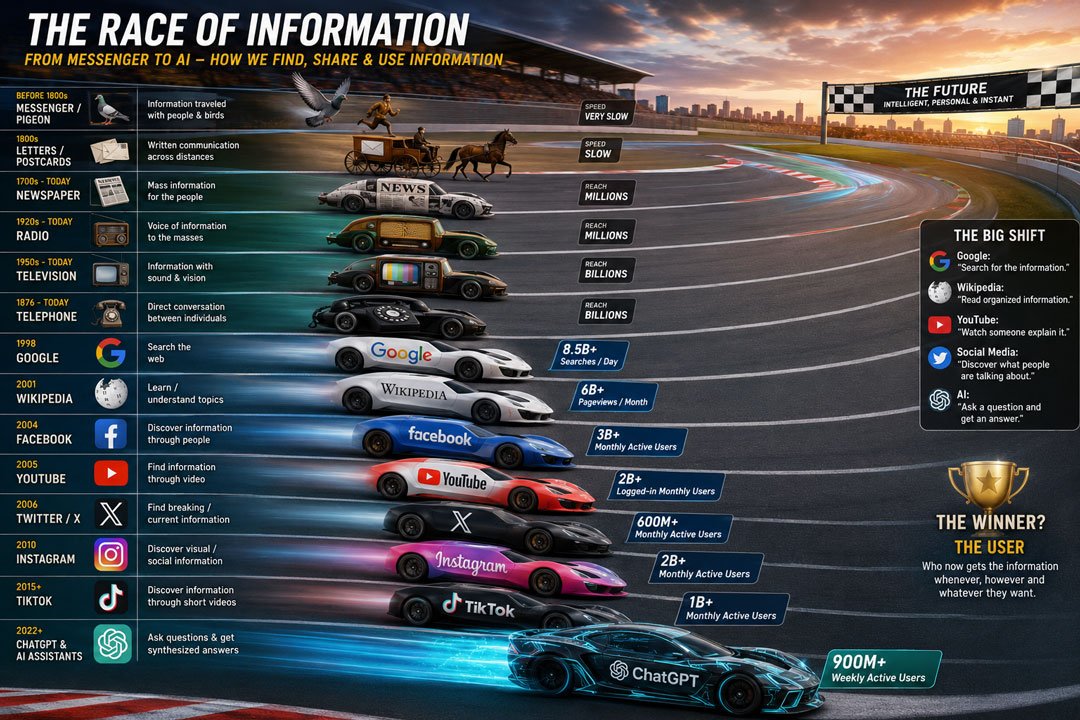
There was a time when information had to travel before it could reach us. A messenger walked between villages. A pigeon carried a note across a valley. A letter took days, sometimes weeks, to arrive. Today, a student can type a question and receive an explanation, a summary, a translation or a comparison within seconds. The distance between wanting to know something and actually knowing it has collapsed — and it has collapsed within a single human lifetime.
This is not simply a story about gadgets. It is the story of who controlled information at each stage, and how that control kept shifting — from the editor, to the broadcaster, to the search engine, to the crowd, and now to a machine we can hold a conversation with.
Stage One: When the Editor and the Broadcaster Decided
For most of human history, information moved at the speed of the person, animal or bird carrying it. Newspapers changed the scale of this — a single edition could reach thousands, then millions, of readers. Radio removed the need to read; television added pictures to sound. But at every stage there was a gatekeeper. A newspaper's editors chose the stories. A broadcaster chose the programme. The audience could choose which paper or channel to follow, but could not turn to it and say, "tell me exactly what I want to know." Information was delivered; it was not yet something people could request on demand.
Stage Two: Google Changed the Question
Larry Page and Sergey Brin met at Stanford University in 1995 and began working on a search engine originally called BackRub. It was renamed Google, and the company was formally established in 1998. What followed was less a business story than a change in human habit: people stopped asking "who knows this?" and started asking "let me Google it." Nearly three decades later, Google's dominance of search has barely wavered — StatCounter put its worldwide search-engine market share at over 91% in June 2026.
traffic runs
through Google
Global Search Engine Market Share
On January 15, 2001, Wikipedia launched, founded by Jimmy Wales and Larry Sanger. It solved a different problem: Google helped people find pages; Wikipedia helped them understand a subject in one organised place, built and edited collaboratively by volunteers rather than a single publisher. In 2025, the Wikimedia Foundation reported roughly 965 million unique devices accessing Wikipedia over the year — a scale that would have been unimaginable to the encyclopaedia-sellers of a century earlier.
Google, founded 1998
91.27% search shareStatCounter, worldwide search-engine market share, June 2026.
Wikipedia, launched 2001
~965 million devicesUnique devices accessing Wikipedia in 2025, Wikimedia Foundation.
ChatGPT, launched Nov 2022
~900 million weekly usersOpenAI-reported weekly active users, early 2026.
Gemini, Google's AI
950 million monthly usersGoogle's Q2 2026 earnings update; available in 230+ countries.
Figures are the most recent company-reported estimates available and should be read as such — platforms rarely publish directly comparable methodologies.
Stage Three: Everyone Became a Publisher
Between 2003 and 2010, a cluster of platforms changed who got to speak, not just who got to listen. Facebook (2004), YouTube (2005), Twitter, now X (2006), and Instagram (2010) meant that a student, a teacher or a small business could reach an audience that once required a printing press or a broadcast licence. WhatsApp (2009) took this a step further, moving information into family groups, school groups and neighbourhood circles — powerful, but also a channel where a false claim can travel exactly as fast as a true one.
Bar length is scaled to Facebook's reported 3.07 billion monthly active users. User bases overlap heavily across platforms and are not additive. Figures are company-reported, most recent available (2025–26).
One Country Keeps Topping Every List: India
Zoom in from global totals to individual countries, and a single pattern repeats across almost every major platform. India is not just a large market — it is the single largest national user base on Facebook, YouTube, Instagram and WhatsApp simultaneously, a distinction no other country holds on even one of these platforms at the same time.
Top 10 countries by WhatsApp users, 2026 (millions). India's user base is nearly six times that of second-placed Brazil. Source: company-reported and industry estimates compiled via TimelinesAI, DataReportal and Statista, 2026.
The Top 10, Platform by Platform
| Rank | Facebook (M) | YouTube (M) | Instagram (M) | WhatsApp (M) |
|---|---|---|---|---|
| 1 | India — 380 | India — 467 | India — 414 | India — 853.8 |
| 2 | USA — 195 | USA — 238 | USA — 172 | Brazil — 148 |
| 3 | Indonesia — 165 | Brazil — 147 | Brazil — 141 | Indonesia — 112 |
| 4 | Brazil — 140 | Indonesia — 139 | Indonesia — 100+ | USA — ~100 |
| 5 | Mexico — 95 | Mexico — 83 | Turkey — 60 | Mexico — 69.7 |
| 6 | Philippines — 92 | Japan — 78 | Japan — 55 | Russia — 66.7 |
| 7 | Vietnam — 78 | Germany — 67 | Mexico — 50 | Pakistan — 52.3 |
| 8 | Bangladesh — 52 | Vietnam — 63 | UK — 35 | Germany — 51.9 |
| 9 | Egypt — 48 | Russia — 60 | Germany — 32 | Philippines — 51.2 |
| 10 | UK — 45 | Philippines — 57 | Argentina — 28 | Nigeria — 51 |
All figures are company-reported or industry-estimated user bases, most recent available (2025–26), compiled from Meta, Alphabet, DataReportal, Statista and BusinessStats. Meta and Alphabet do not officially disclose exact country-level user counts; figures carry a margin of error of roughly ±5–15% and should be read as estimates, not audited data.
India: #1 on four platforms at once
Facebook, YouTube, Instagram, WhatsAppNo other country tops the country-rankings on more than one major platform simultaneously.
USA: consistently #2
2nd on Facebook, YouTube & InstagramSmaller by user count, but generates a disproportionate share of ad revenue on every platform.
Brazil: the steady #3
Top 3 on all four platformsLatin America's largest and most consistently engaged digital market.
Indonesia: the quiet giant
Top 4 on all four platformsSoutheast Asia's largest population is also becoming its largest digital audience.
Stage Four: The Speed of Adoption Itself Changed
Perhaps the clearest sign of how the pace of the information age has accelerated is not how many people use a technology, but how quickly they started. Radio took decades to reach a mass audience. Television took over a decade. Generative AI took weeks.
Approximate time each technology took to reach 100 million users, based on widely cited industry estimates. Shorter bars mean faster adoption — ChatGPT's climb is barely visible next to radio's.
The Milestones, Side by Side
| Year | Development | Founder(s) / Origin | What Changed |
|---|---|---|---|
| 1998 | Larry Page & Sergey Brin, Stanford | Information became searchable | |
| 2001 | Wikipedia | Jimmy Wales & Larry Sanger | Knowledge became collaborative |
| 2004 | Mark Zuckerberg & co-founders | Information became social | |
| 2005 | YouTube | Hurley, Chen & Karim | Learning became visual |
| 2009 | Jan Koum & Brian Acton | Sharing became personal & instant | |
| 2010 | Systrom & Krieger | Discovery became visual | |
| 2014 | Alexa | Amazon | People began speaking to machines |
| 2022 | ChatGPT | OpenAI | Search became conversation |
| 2023–26 | Gemini & other AI | Google and others | Answers became personalised |
What This Means for Students
Earlier generations of students were limited mainly by access — how many books their school library held, how far the nearest good teacher lived, whether the local newspaper covered a subject at all. Today's student has the opposite problem: not scarcity, but overload. A search can return millions of pages; a chatbot can produce a confident paragraph in seconds. The scarce resource is no longer information — it is the judgment to tell reliable information from unreliable information, and a well-organised source from a noisy one.
Questions Worth Asking Before You Trust an Answer
- Who created this — a person, an institution, or an AI system — and when?
- Is this a fact, a fluent guess, or someone's opinion presented as fact?
- Can it be verified against an independent, reliable source?
- Has a number, quote or image been taken out of its original context?
- Would I still trust this if I slowed down and checked it before sharing it?
CampusNewz.com: Organising the Information That Matters
This is precisely the gap CampusNewz.com aims to close for students and parents navigating education and careers. The problem was never that information about streams, courses, colleges and entrance exams did not exist online — it was scattered across hundreds of sources of uneven reliability. Our stream-wise career guides and Colleges Directory exist to bring that information into one organised, verifiable place, so families spend their time making decisions rather than hunting for facts.
Once, information had to find us. Then we learned to search for it. Then we learned to share it. Now we can simply ask for it — in the language, depth and format we choose. The next chapter will not be about access. It will be about judgment: knowing what to trust, and what to do with what we know.