
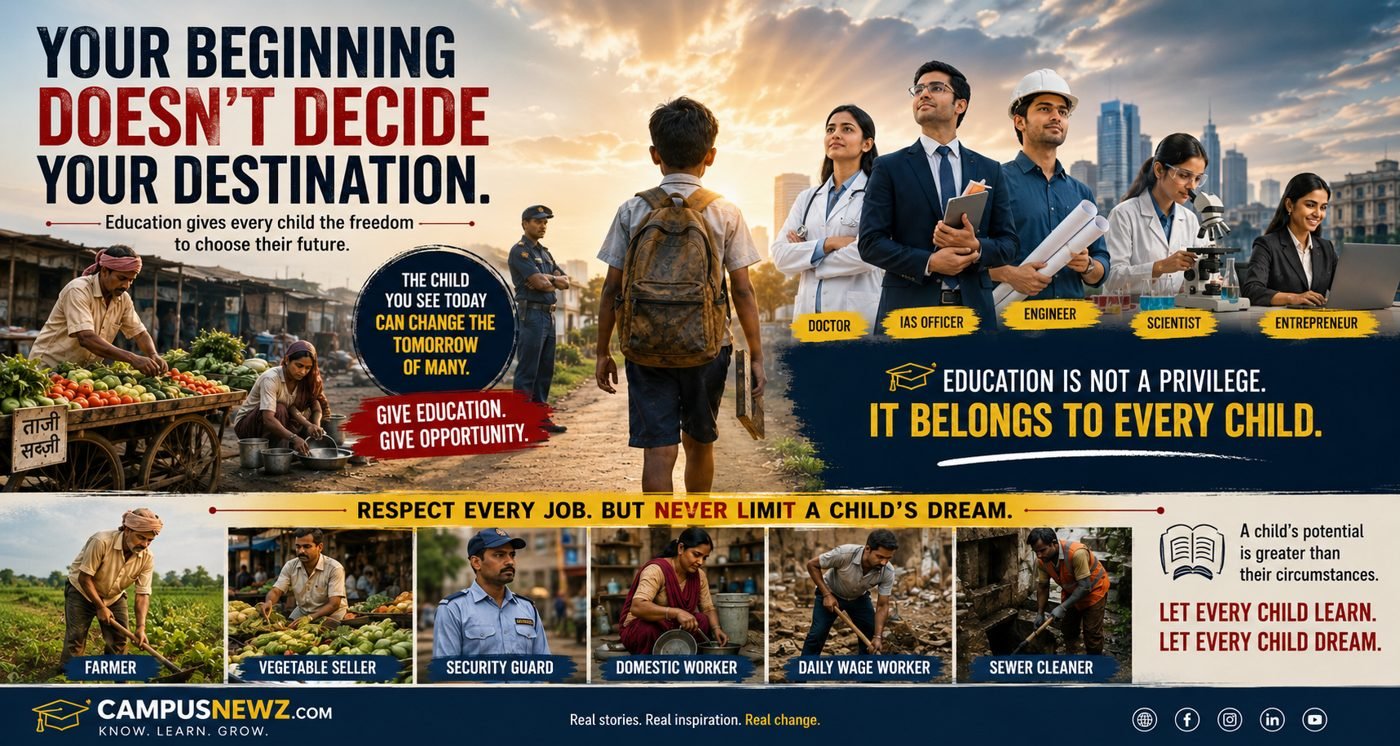
Every morning, a child wakes up, puts on a school uniform, picks up a schoolbag and walks towards school. For the child, it may feel like an ordinary morning. But before that child reaches the classroom, hundreds of things have already happened — someone has cleaned the street, collected the garbage, opened the school gates, delivered the milk, driven the bus, guarded a building, and worked through the night to keep a hospital running. And then the child reaches school. The classroom is clean. The water is available. The roads are usable. The city is moving. But how often does the child stop to think about the people who made that ordinary morning possible?
One Morning, a Child Started Noticing
Imagine a child named Aarav. One morning, while walking to school, he saw a sanitation worker cleaning the road — a man he had seen many times before but never really looked at. He saw a woman washing utensils outside a house, who had probably started work before anyone inside had even woken up. He saw a security guard who had stood outside a building all night. At the vegetable market, he saw a farmer unloading sacks of produce. Aarav suddenly realised something: the people he usually walked past were doing work that touched his own life every single day. They were not invisible. He had simply never noticed them.
The People Who Make Our Lives Possible
We often measure people by job titles — doctor, engineer, IAS officer, teacher, scientist. But society also depends on people whose job titles rarely appear in newspapers: the sanitation worker who removes waste, the person who cleans a hospital, the worker who maintains a sewer, the farmer who grows food, the driver who takes children to school, the domestic worker who cleans homes, the construction worker who builds roads and houses, the electrician, the plumber, the waste collector. These people are part of the invisible infrastructure of everyday life. We notice them most when they stop working.
A Child's Question
That evening, Aarav asked his mother: "Why do these people do such difficult work?" She replied, "Because every society needs people who are willing to do every kind of work." Aarav thought for a moment. "But why don't their children do something else?" His mother looked at him and said simply: "They can." That answer stayed with him. The daughter of a domestic worker can become a doctor. The son of a security guard can become an engineer. The son of a farmer can become an IAS officer. The child does not have to inherit the parent's occupation. And there is nothing wrong with choosing the same occupation either — that is the important distinction.
Respect the Work. Don't Restrict the Child.
There is a mistake we sometimes make while talking about education — we say it will help children "escape poverty." A farmer should not be told farming is inferior. A sanitation worker should not be treated as lesser. A domestic worker should not be treated as someone without dignity. Their work contributes to society; their labour has value. The goal of education is not to make children look down on the occupations their parents perform. The goal is to give children choice.
The daughter of a domestic worker can become a doctor. The son of a security guard can become an engineer. The child does not have to inherit the parent's occupation — but there is nothing wrong with choosing it either.
— Aarav's motherTukaram Mundhe: A Child of the Fields
Tukaram Mundhe was born in Tadsonna village, Beed district, Maharashtra, in a farming family. He studied at a Zilla Parishad school while helping with ploughing, sowing, watering crops, and selling produce at weekly markets. His family faced financial difficulties in a drought-prone region. But the boy who worked in the fields did not have to remain confined to them — he studied History and Political Science, and in 2004 secured All India Rank 20 in the UPSC Civil Services Examination, joining the 2005 batch of the IAS on the Maharashtra cadre. His story is not about "escaping" farming — farming is not something to escape. It is about a farmer's child being given the freedom to choose.
Deep Dive: One Officer's Two-Decade Fight for "Health For All"
What makes Mundhe's journey worth studying closely is not just where he began, but what he chose to do once he had the power to act. Across more than two decades and 25 transfers, an unusually large share of his postings have circled back to one theme: public health, and specifically the health of people — including children — who have the least ability to demand it for themselves.
Building the Foundations: Family Welfare, the National Health Mission and AIDS Control
Early in his career, Mundhe held postings tied to the Family Welfare department, the National Health Mission (NHM) — India's flagship rural and urban public-health programme that funds maternal care, child immunisation and community health workers — and the Maharashtra State AIDS Control Society. These are not glamorous postings; they are the administrative machinery behind vaccination drives, maternal health camps and disease-control programmes that rarely make headlines but decide whether a child in a village gets basic healthcare at all.
Navi Mumbai: Naming Health as a Day-One Priority
When Mundhe took charge as Navi Mumbai Municipal Commissioner in 2016, he made his priorities public on his very first day, stating that the health system, water supply and sanitation would receive special attention, alongside a push for e-governance so residents' complaints — including on sanitation and health — could be tracked without repeated visits to the head office. During his tenure, he also held ward-level "walk with the commissioner" sessions where residents raised sanitation, water supply and health complaints directly, with commitments to resolve local issues within one to two weeks.
Nashik: Cleaning Up the City Children Walk Through Every Day
As Nashik Municipal Commissioner (2014–2016), Mundhe pushed reforms to infrastructure, waste management and civic amenities, introducing a transparent grievance-redressal system so citizens — including those raising sanitation and public-health complaints — could get faster responses. Clean streets, functioning drains and managed waste are not abstract civic goals; they are the same "invisible infrastructure" that decides whether the walk to school is safe and healthy for a child.
Nagpur, 2020: Building a COVID-19 Response Around the Most Vulnerable
Mundhe's most tested public-health moment came as Nagpur Municipal Commissioner during the first wave of COVID-19. He restructured the city's response around risk-based triage — asymptomatic patients in COVID care centres, moderate-to-severe cases in dedicated COVID hospitals — and scaled up antigen testing for anyone showing influenza-like or severe respiratory symptoms, coordinating capacity across government hospitals including Indira Gandhi Government Medical College, Government Medical College and Hospital, and AIIMS Nagpur. He also directed civic teams to monitor private hospitals to prevent overcharging of patients. Perhaps most tellingly for a story about people society often overlooks, the Nagpur Municipal Corporation under Mundhe moved roughly 300 homeless people from footpaths into seven shelter homes, arranging medical check-ups for each of them and coordinating with NGOs for food — a direct, practical answer to the question this article keeps asking: what happens to the people no one is watching, when a crisis makes them impossible to ignore?
2026, Maharashtra FDA: Taking the Fight Directly to School Gates
Since taking charge as Commissioner of the Maharashtra Food and Drug Administration in May 2026, Mundhe has led one of the state's largest food-safety enforcement drives, with more than 1,100 inspections of restaurants, manufacturers and distributors, and crackdowns on adulterated food and counterfeit medicines. Within that campaign, he specifically ordered a ban on the sale of junk food and soft drinks in and around school campuses — a direct, targeted intervention for child health, aimed at the food environment children encounter every single day on their way in and out of school. It is arguably the clearest example in his career of "health for all" narrowed down to its most literal audience: children themselves.
Every year, now and then, a kid has to be admitted in a new school.
— Tukaram Mundhe, on being transferred for the 12th time, comparing it to a child changing schoolsEven the metaphor Mundhe reaches for when explaining his own repeated transfers is a child's experience — being enrolled in a new school year after year. It is a small detail, but it captures something about how consistently his frame of reference, across health postings, civic reform and food regulation, keeps returning to the same question this article has been asking all along: who is this system actually protecting, and are its children among them?
The Child of a Rickshaw Puller, and the Boy from the Tea Stall
Govind Jaiswal grew up in Varanasi in a financially struggling family; his father worked as a rickshaw puller. Govind continued his education, prepared in Delhi, and cleared the UPSC Civil Services Examination in 2006 with All India Rank 48. Himanshu Gupta's father was a daily-wage worker who later ran a tea stall; Himanshu helped there while studying, and eventually entered the IAS after clearing the UPSC examination three times. Neither the rickshaw nor the tea stall was their destiny — only their family's livelihood at the time.
| Workforce | Official / Lower Estimate | Unofficial / Wider Estimate | Source |
|---|---|---|---|
| Domestic Workers | ~4.7–5.2 million | Estimated up to 40–90 million | ILO / PLFS; NGO & press estimates |
| Gig & Platform Workers | 7.7 million (2020–21) | Projected 23.5 million by 2029–30 | NITI Aayog |
| Manual Scavengers | 34,859 identified | Still active despite bans | National Commission for Safai Karamcharis |
| Sewer & Septic Tank Deaths | 801 reported since 1993 | Widely believed under-reported | National Commission for Safai Karamcharis |
| SKA Founded / Legal Ban | 1993 | Practice persists 30+ years on | Safai Karamchari Andolan (Bezwada Wilson) |
The Man Who Made Sanitation Workers Impossible to Ignore: Bezwada Wilson
If Mundhe represents change from inside the administration, Bezwada Wilson represents change forced from outside it. Born in 1966 in the Kolar Gold Fields in Karnataka to parents who were both manual scavengers, Wilson discovered as a child that the word other boys used to taunt him — "Thoti" — meant scavenger, and that his own family's work was the very thing society refused to look at directly. In 1993, the same year manual scavenging was officially banned by law in India, Wilson co-founded the Safai Karamchari Andolan (SKA), a grassroots movement that has spent more than three decades pushing the ban from paper into practice.
SKA's methods have been deliberately practical: documenting deaths of workers in sewers and septic tanks that officials often failed to record, taking cases to court, physically demolishing dry latrines that forced manual scavenging, and — critically for this article's argument — lobbying government for scholarships for scavengers' children and organising vocational training for female scavengers, so that the next generation would have a route out of the same work their parents were never given a choice about. Wilson received the Ramon Magsaysay Award, often described as Asia's equivalent of the Nobel Prize, in 2016, for what the award citation called his moral energy in leading a grassroots movement against this "degrading servitude."
Wilson's own words cut to the heart of what this article has been arguing: manual scavenging, he has said, is not a scavenger's problem alone — it is a problem for the entire country, because a society that allows one group of citizens to do its most dangerous, most degrading work while denying their children a path out of it has not actually solved anything. It has simply made the problem invisible.
The People Who Keep Us Healthy and Safe
Think about a hospital. We see doctors and nurses, but behind every functioning hospital is a much larger team — someone cleans the floors, handles waste, maintains equipment, transports patients, prepares food, and works through the night. The doctor cannot work effectively without this ecosystem. The same is true outside hospitals: a security guard standing outside a school, a worker maintaining a road, a firefighter running towards danger, a sanitation worker entering a difficult environment — these are not small contributions. They are part of the foundation of a functioning society.
Then What Should Happen to Their Children?
If society depends on these workers, society also has a responsibility towards their children — not charity, not pity, but opportunity. Their children should have good schools, teachers, books, access to computers and the internet, knowledge of scholarships, and career guidance. They should know that IIT, AIIMS, central universities, professional colleges, civil services and thousands of other paths are open to them. A child cannot aspire to a profession he or she has never heard about.
- Security Guard's Child, Loves Maths
- Domestic Worker's Daughter, Loves Biology
- Farmer's Son, Fascinated by Machines
- Vegetable Seller's Daughter, Loves Writing
Education Should Open Doors, Not Create Hierarchy
We must be careful about the message we give children. Education is not valuable because it lets someone say "I am better than you because I have a degree." Real education should make us understand the value of other people's work. A doctor needs a sanitation worker. A scientist needs a laboratory assistant. A school needs cleaners and support staff. A country is not built by one profession — it is built by millions of people doing different jobs. Education should make us more respectful, not more arrogant.
A Different Definition of Success
Success should not simply mean earning more money than your parents. It can mean becoming the first graduate in your family, educating a younger sibling, helping parents retire with dignity, becoming a teacher who educates hundreds of children, or a farmer using science and technology to improve productivity. The purpose of education is not to create one definition of success — it is to give people the ability to define their own.
- Respect every honest worker
- Never let a parent's occupation limit a child's future
- Give every child's talent a fair chance to be discovered
- Measure success by choice and dignity, not only income
The parent's work deserves our respect. The child's potential deserves our opportunity.
— The People We Often Don't SeeThe Final Lesson
The next time we see someone cleaning a road, collecting garbage, guarding a building, working in a field, selling vegetables, or repairing a pipeline, perhaps we should pause. That person is doing something for society — something we often notice only when it stops happening. And perhaps beside that worker, or at home after work, there is a child studying a schoolbook. Do not look at that child and see only the parent's occupation. Look again — you may be looking at a future doctor, engineer, scientist, teacher, entrepreneur, civil servant, or simply a future citizen who will make the world a little better.
(Compiled from reflections on Indian civil servants whose journeys began in economically modest, working-class households, alongside widely reported labour and workforce data, and press coverage of Tukaram Mundhe's public-health postings and Bezwada Wilson's work with the Safai Karamchari Andolan.)