
16-Year-Old Lakshmanan Meyyappan Becomes World’s Youngest Chartered Accountant VIEW NOW →
 The Silence Usually Begins Much Earlier

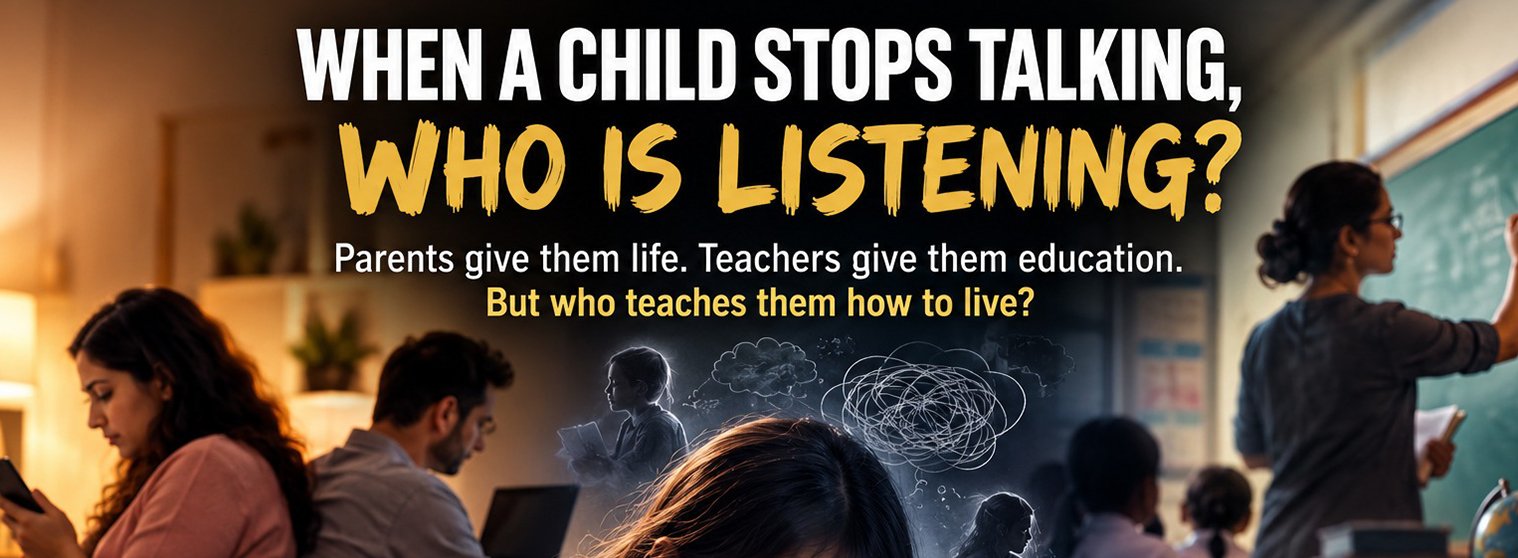
A Child Doesn't Go Quiet
All at Once — It Happens Slowly

It may begin with a boy who once came home excited to talk about a football match. A girl who learns that her questions bring irritation. A teenager who says "I am tired" and hears "Everyone is tired. Study." Sometimes nobody knows why — the child simply becomes quieter.

Bullying & Humiliation
Laughter in Class Can Follow a Child Home
Being laughed at may seem harmless to an adult. To the child who experienced it, it may become humiliation that follows them home — and in some recent cases, repeated complaints went unanswered for months.
Bullying is not "part of growing up." Never answer it with "just ignore them."
Pressure & Comparison
"Your Cousin Got 95%"
A failed examination may seem like one bad day to a parent. To a child, it may feel like the end of his identity. Comparison sounds ordinary at the dinner table — it can quietly dismantle confidence.
A mark is information. It is not an identity.
Loneliness
Alone in a Classroom of Fifty
Loneliness isn't simply being physically alone. A friendship that broke may have been a teenager's entire social world. WHO flags social withdrawal and isolation as key concerns in adolescent mental health.
The quiet child may need attention as much as the disruptive one.
Home & the Unknown
And Sometimes, Nobody Knows Why
Problems at home, a teacher's harsh words, a broken friendship, something online — or nothing anyone can name. Suicide is never the result of one simple cause, which is exactly why noticing early matters.
A child's "small" problem can be enormous in the mind of a child.
The family calls it
"Just a phase"
The school calls it
"A behaviour issue"
The teacher calls it
"Indiscipline"
The parents call it
"Teenage attitude"
And the child slowly learns one dangerous lesson
"Nobody really wants to hear what I have to say." — That is where the real crisis can begin.
 India, By the Numbers

Behind Every Number Was a Son, a Daughter, a Friend

14,488
Students Lost to Suicide in 2024 — a Record
NCRB's latest report, released in May 2026, shows student suicides rising even as India's overall suicides dipped slightly.
  • Up about 4.3% from 13,892 in 2023
  • Students were 8.5% of all 1,70,746 suicides in 2024 (7.6% in 2022)
  • Over 1.23 lakh students lost between 2014 and 2024
NCRB, Accidental Deaths & Suicides in India 2024
3,101
Children Under 18 Where "Family Problems" Was the Cause
"Family problems" is the single largest reported cause of suicide in India — 33.5% of all cases in 2024.
  • Illness follows at 17.9%; failure in examination is 1.2% of all cases
  • Maharashtra recorded the most student suicides (1,909)
  • Recorded causes are a starting point — rarely the full story
NCRB ADSI 2024 · as reported by ETV Bharat
44.4%
Said Parents Didn't Understand Their Worries
In WHO's school-based student health survey data for Jaipur, the gap between young people's experiences and adult understanding is stark.
  • 13.1% felt lonely most of the time or always in the past year
  • Figures are from one surveyed population, not a national estimate
  • India has about 253 million adolescents aged 10–19
WHO Global School-Based Student Health Survey · UNICEF India

Student Suicides in India — An 11-Year Climb

Recorded cases per year · 2014 to 2024
Source: NCRB, Accidental Deaths & Suicides in India (ADSI), 2014–2024

Reported Causes of All Suicides, India 2024

Share of 1,70,746 cases · family problems lead by a wide margin
Source: NCRB ADSI 2024 · "Other / unknown" includes remaining categories
 Around the World

This Isn't Only an Indian Story — Children Everywhere Are Struggling

From Tokyo to Texas, the pattern repeats: young people's distress is rising or stuck at high levels, and the adults around them often find out last.

Global
WHO · UNICEF
1 in 7
10–19-year-olds worldwide lives with a mental disorder — 15% of the disease burden in this age group.
  • Suicide is the third leading cause of death among 15–29-year-olds
  • UNICEF (Sept 2026): one adolescent aged 15–19 dies by suicide every 9 minutes
WHO fact sheet, Sept 2025 · UNICEF, Sept 2026
Japan
Record student suicides
538
school students died by suicide in 2025 — the highest on record, even as Japan's total suicides fell to the lowest since 1978.
  • 10 elementary, 172 junior high and 356 high-school students
  • More girls (280) than boys (258)
Japan Ministry of Health / National Police Agency via Jiji, Mar 2026
United States
High-school students
40%
of high-school students felt persistently sad or hopeless; 1 in 5 seriously considered suicide.
  • Teen girls hardest hit: 53% persistent sadness, 27% considered suicide
  • Bullying at school rose to 19% from 15% in 2021
CDC Youth Risk Behavior Survey, 2023
United Kingdom
England, ages 8–16
1 in 5
8–16-year-olds in England (20.3%) had a probable mental disorder in 2023.
  • England's 2026 safeguarding guidance for schools (KCSiE) expands its mental-health section
  • Schools are increasingly treated as the first line of noticing
NHS England, MHCYP Survey 2023 · KCSiE 2026
Australia
Social media & minors
Under 16
Since December 2025, major social platforms must keep under-16s off — the world's first national age ban.
  • Early reports suggest many teens are still finding ways online
  • A reminder: rules can't replace a parent who asks what's happening online
Online Safety Amendment Act, in force 10 Dec 2025
The AI Question
Chatbots & teens
Jan 2026
Google and Character.AI agreed to settle US lawsuits by families who said chatbots played a role in teens' suicides and self-harm.
  • Character.AI barred under-18s from open-ended chats in Oct 2025
  • A separate lawsuit against OpenAI over a 16-year-old's death continues; the company denies responsibility
CNN · Fortune · Washington Post, Jan 2026

US Teens: Girls Carry a Heavier Load

% of US high-school students, 2023
Source: CDC Youth Risk Behavior Survey 2023

Japan: Student Suicides Keep Rising

Elementary, junior-high & high-school students · 2022–2025
Source: Japan MHLW / National Police Agency (via Jiji Press)
 Recent Incidents & Latest Developments

Thirteen Students, Fifteen Months — Headlines We Can't Ignore

We report these cases to learn from them, not to sensationalise them. In line with WHO guidance on responsible reporting, we have left out methods and the names of students and institutions, and give only the city and state. Every one of them was a person with a family and a future.
2026 — School Students
Five cases, ages 12 to 18
Jul 2026Anekal, Bengaluru · KarnatakaSchool · Age 13
A Class 8 girl, a fine of ₹20 and unfinished homework
A 13-year-old Class 8 student died by suicide. Police said a note allegedly referred to punishment over incomplete homework and a ₹20 fine. Her family alleged harassment and humiliation by school staff, and police investigated the circumstances.
Punishment should never cost a child their dignity. A child who is humiliated over homework is not learning about responsibility; they are learning shame.
As reported, July 2026
Jul 2026Bengaluru · KarnatakaSchool · Age 13
Made to stand outside the classroom, a 13-year-old survived a suicide attempt
A Class 8 boy allegedly attempted suicide after he was reportedly made to stand outside his classroom as punishment. His family said he had earlier complained of harassment and casteist slurs. An FIR was registered.
When a child reports slurs or harassment, the complaint is the warning sign. Act on it before it turns into a crisis.
As reported, July 2026
May–Jun 2026PunjabSchool · Age 17
A Class 12 student and a family's allegation of pressure over unpaid fees
A 17-year-old Class 12 girl died by suicide. Her family alleged mental harassment by the school management over unpaid fees. Police registered a case after a video statement the student had made was reported.
A family's money problems should never be settled through a child. Fee disputes belong with the adults.
As reported, May–June 2026
18 Feb 2026Nagpur · MaharashtraSchool · Age 18
A board exam paper, then a family's worst evening
An 18-year-old Class 12 student died by suicide hours after returning home from her Physics board examination. Police registered a case and began an investigation.
Exam season is the highest-pressure window of the year. A paper is one day; a child is a lifetime. Check in after every exam, not only after the results.
Careers360, Feb 2026
5 Jan 2026Latur · MaharashtraSchool · Age 12
A 12-year-old hostel student, and a family left with questions
A Class 6 girl died at a residential government school. Her family protested and demanded an investigation into the school administration, saying they had first been told she was unwell.
Children living away from home need a named, trusted adult. Families need honest and timely communication.
Careers360, Jan 2026
2025 — School Students
The cases that made the country ask who was listening
1 Nov 2025Jaipur · RajasthanSchool · Age 9
A 9-year-old asked her teacher for help five times in 45 minutes
A Class 4 student died by suicide at her school. Her parents alleged she had been bullied repeatedly by classmates and that her complaints were not properly addressed. A CBSE inquiry found she had approached her class teacher five times in her final 45 minutes. CBSE later cancelled the school's senior-secondary affiliation, and the case stayed in the news through 2026, including over CCTV footage.
She was asking to be heard. A system that treats bullying complaints as routine can miss the moment that matters most.
Tribune India · WION · The Week (PTI), Dec 2025
Nov 2025New Delhi · DelhiSchool · Age 16
A Class 10 student's family alleged harassment by teachers
A 16-year-old Class 10 student died by suicide. His family later alleged he had been harassed by teachers. Four members of the school's teaching staff were suspended and the government ordered an inquiry.
A teacher's joke or insult can stay with a child for life. If a child's safety is at risk, parents must be told.
Careers360 · as reported, Nov 2025
2025–2026 — College & University Students
The pressure doesn't end when school does
Sep 2026Mumbai · MaharashtraCollege · Engineering
An engineering student, a phone found in an exam hall
A BTech student died by suicide shortly after he was allegedly found with a mobile phone during an examination. His parents later filed a police complaint alleging abetment and caste-related discrimination. These allegations are under investigation.
Even when a rule really was broken, the response has to leave room for a young person's future. Discipline without dignity can feel like the end of the road.
As reported, Sep 2026
Jul 2026Gadwal · TelanganaCollege · Age 18
An Intermediate student's family said a teacher humiliated and slapped him
An 18-year-old Intermediate second-year student at a government junior college died by suicide. His family alleged that a teacher had humiliated and slapped him. Police booked the teacher for alleged abetment of suicide.
Physical punishment and public humiliation have no place in any classroom, at any age.
As reported, July 2026
Apr 2026Kannur · KeralaCollege · Age 22
A dental student; Supreme Court refuses a professor anticipatory bail
A 22-year-old dental student died. His family and fellow students alleged repeated humiliation and harassment by teachers. In July 2026 the Supreme Court refused anticipatory bail to a professor facing abetment-of-suicide charges.
His classmates spoke up for him. Peers often see the harm first; institutions must make it safe for them to report it.
As reported, Apr & Jul 2026
Dec 2025Jaipur · RajasthanUniversity · Age 19
A 19-year-old from Patna, caught allegedly cheating in an exam
A university student from Bihar died by suicide after he was allegedly caught cheating in an examination, police said.
A mistake in an exam hall is serious, but it can be recovered from. Young people need to hear that from an adult in the hours afterwards.
The Indian Express, Dec 2025
2025–2026GoaUniversity · Ages 19–20
A police probe into several student deaths on one campus
Police investigated several student deaths at a university campus in Goa. The investigation pointed to academic stress as a probable factor in at least three of the suicides. The students were around 19 to 20 years old.
When several students on one campus are affected, the cause is unlikely to be any one student. Look at the system around them.
The Indian Express
Jul 2025Greater Noida · Uttar PradeshUniversity · Age 21
A dental student's note accused faculty of humiliation
A 21-year-old second-year BDS student died by suicide in her hostel. A purported note accused faculty members of humiliation and mental harassment. Police arrested two faculty members and booked others for alleged abetment.
Hostel students are far from family. Faculty are the adults closest to them, and they carry that responsibility.
The Indian Express, Jul 2025
Policy, Data & Global Developments
What governments, courts and global agencies did
7 Jan 2026United StatesGlobal
AI chatbot makers settle teen suicide lawsuits
Google and Character.AI agreed in principle to settle lawsuits from families, including that of a 14-year-old, who said AI companions deepened their children's isolation and distress. No liability was admitted.
"Why are you always on your phone?" misses the point. Ask: "Who are you talking to — and how does it make you feel?"
CNN · Fortune · Axios, Jan 2026
May 2026IndiaData
NCRB: student suicides hit a record 14,488
The 2024 ADSI report showed student suicides rising faster than India's overall suicides, which fell 0.4%. Maharashtra, Tamil Nadu and Madhya Pradesh recorded the most suicides overall.
NCRB ADSI 2024 · The Wire · ETV Bharat
Jun & Sep 2026IndiaPolicy
Supreme Court task force: "a structural problem, not an individual one"
The National Task Force led by former Justice S. Ravindra Bhat found that over 70% of higher-education institutions lack a full-time mental-health professional and fewer than 4% have a suicide-risk management policy. Its survey found 9% of students reported suicidal thoughts and 34% felt like outsiders on campus. It asked NCRB to track school and college suicides separately. The final report is due by 31 October 2026.
NTF interim report via InsightsIAS (Jun 2026) · Daily Jagran (Sep 2026)
9–10 Sep 2026Geneva / GlobalGuidance
WHO, UNESCO & UNICEF: teachers are "frontline adults"
WHO's new guide, Teaching with care, asks teachers to build safe classrooms, notice distress early and refer students to support, without diagnosing or treating them. A day earlier, on World Suicide Prevention Day, UNICEF warned that an adolescent dies by suicide every nine minutes and called schools key places for prevention.
WHO, 10 Sep 2026 · UNICEF Italia, 9 Sep 2026

What Families and Police Pointed To

Number of the 13 student cases above in which each factor was alleged or reported. Many cases involve more than one factor.
Source: CampusNewz analysis of the cases above, based on news reports. Allegations, not findings.

School or College? Age at the Time

Ages of the 13 students in these cases. The Goa case is counted once, at about 20.
Source: CampusNewz analysis of reported cases, Jul 2025 – Sep 2026
 The Listening Gap

They Listen to the Results — Not the Child's Feelings

When a child stops talking, adults may see silence. A mental-health professional may see a possible warning sign. The intention may be love — but love without listening can become pressure.

What Indian Students Report

% of surveyed students · different surveys and populations, shown side by side
Sources: WHO GSHS (Jaipur, school students) · Supreme Court NTF survey 2026 (higher-education students)

Who's There When Students Need Help?

Share of Indian higher-education institutions with and without a full-time mental-health professional
Source: Supreme Court-appointed National Task Force, interim report, June 2026
Instead of asking…
Also ask…
"How much did you score?"
"How are you feeling?"
"Who came first?"
"What did you learn?"
"Why are you behind him?"
"What is making studying difficult?"
"Why are you always on your phone?"
"Is something happening online or with your friends?"
"Did you finish your homework?"
"Did anything upset you today? Did anyone make you uncomfortable?"
"Mummy, I don't feel good."
Answered with: "Don't overthink. You're too young to have problems."
"I don't think anyone understands me."
The sentence that can open a door — if someone stays
"I may not understand everything you're going through, but I am here. Tell me."
The most powerful sentence a parent can say
 Two Ordinary Children

Aarav and Meera Could Be Anyone's Child

Composite stories, drawn from patterns counsellors see every day.

Aarav
14 · Loves cricket & technology

His parents love him. They want good marks, a good college, a better life than they had. Gradually his marks decline, he stops playing cricket, sleeps late and gets irritated over small things.

Mother: "Why are you so quiet these days?"  Aarav: "Nothing."
Father: "Nothing? Your marks are going down. You have to concentrate."
 One evening his father sits beside him: "I've been asking you about marks for months. Maybe I forgot to ask you how you are." He waits. Aarav finally speaks. With a counsellor, the school and his friends involved, he slowly starts playing cricket again. No miracle — just someone noticed.
Meera
15 · Third row, rarely any trouble

She completes most of her work. Her grades are average. Nobody worries about her.

Her teacher thinks: "She is quiet."
Her classmates think: "She doesn't talk much."
Her parents think: "She is becoming independent."
 Nobody realises Meera feels increasingly alone. The problem isn't that nobody cares — it's that nobody asks the right question. Some of the most distressed students are not disruptive at all.
 The Expert Message

Look. Listen. Link. — A Framework for Every Adult

The national adolescent peer-support module launched by the Government of India with UNICEF in 2025 uses this simple approach. The goal isn't to solve everything in one conversation — it's to make sure the child isn't alone with the problem.

01
LOOK
Look beyond marks
  • The child who stopped laughing
  • The student who stopped participating
  • Sudden changes in sleep, mood, friendships
  • The child who suddenly says "I don't care"
02
LISTEN
Don't interrupt, judge, compare or lecture
  • Don't say "You have everything"
  • Say "Tell me what is happening"
  • Let them finish; don't prepare your reply
  • Then keep listening
03
LINK
Don't try to become the child's therapist
  • Connect the child with the right professional
  • Connect the school with the family
  • Connect the family with mental-health services
  • Connect the student with a trusted adult
 Practical Guidance

What Parents and Teachers
Should — and Shouldn't — Do

A parent doesn't need all the answers — they need to be available. A teacher isn't a psychiatrist — but a teacher can be a bridge to help.

For Parents: The Dos
Small conversations, every day
1
Listen before advising. Ask questions and let them finish.
2
Create regular moments at dinner, on walks or on drives — don't wait for a crisis.
3
Ask about emotions, not just performance: "What was difficult today?"
4
Take bullying seriously and work with the school.
5
Praise effort, kindness and courage. "I am valuable even when I fail."
For Parents: The Don'ts
Ordinary sentences can do deep damage
✕
Don't compare: "Look at Sharma's son."
✕
Don't humiliate — public embarrassment is never a parenting strategy.
✕
Don't dismiss: "You are too young to be stressed."
✕
Don't snatch the phone before understanding why — screens can be an escape from loneliness.
✕
Don't promise secrecy when safety is at risk — seek professional help.
For Teachers: The Dos
Notice, support, refer
1
Recognise behavioural change — who sits alone, who stopped raising a hand.
2
Make mistakes safe: "I don't understand" should never invite ridicule.
3
Teach social-emotional skills: empathy, conflict resolution, stress management.
4
Involve parents when you see concerning changes — communicate rather than just punish.
5
Refer, don't diagnose. Connect students with trained professionals.
For Teachers: The Don'ts
Labels can become identities
✕
Don't publicly shame. A teacher's joke may become a lifelong memory.
✕
Don't label: "Lazy." "Problem child." "Attention seeker." "Failure."
✕
Don't assume silence means fine.
✕
Don't treat distress as indiscipline — withdrawal may need support, not punishment.
✕
Don't ignore bullying, and don't make marks the only measure of intelligence.
What Schools Must Build (1–4)
More than a counsellor's name on a noticeboard
1
A trusted-adult system — every student knows at least one adult to approach.
2
Counselling access that is confidential and easy to reach.
3
Teacher training to recognise distress and respond well.
4
Anti-bullying systems where reporting is safe and complaints are taken seriously.
What Schools Must Build (5–8)
A culture of dignity
5
Parent education on adolescence, digital life, bullying and mental health.
6
Peer-support programmes with clear boundaries and referral pathways.
7
Life-skills education for failure, conflict, rejection and uncertainty.
8
Dignity: no child should fear that asking for help makes them a target.
 CampusNewz's Call to Action

Questions That Never Appear on a Report Card

Parents
Ask "How are you?" before "How much?"
Be present, not perfect
Allow the child to say "I disagree"
Boundaries, yes — and a voice too
Be someone they can return to after a mistake
Teachers
Notice the quiet child, not only the loud one
Check in after visible changes
Never humiliate in public
Tell parents when safety is at risk
Refer to professionals early
Schools
Ask "How many students feel safe here?"
How fast do we act on bullying?
How do we treat students who fail?
How do we treat students who are different?
What happens when a child says "I don't want to come to school"?
Students
Your marks don't define your worth
Asking for help is not weakness
Tell one trusted adult
Include the classmate who sits alone
You are not alone with this
Policy & Society
Fund school counsellors, not just buildings
Track school & college suicides separately (NTF)
Mandatory reporting and accountability
Replace stigma with understanding
Treat mental health as part of education
 Prevention Starts With Noticing

Signals That Are Often Mistaken for "Attitude"

UNICEF and WHO advise watching for changes in sleep, mood, behaviour, friendships, attendance and interest in normal activities. One sign alone isn't a diagnosis — a cluster of changes is a reason to talk.

Emotional
  • Persistent sadness or irritability
  • Sudden anger over small things
  • Hopelessness
Physical
  • Sleeping late or too much
  • Appetite changes
  • Constant tiredness, headaches
Social
  • Sitting alone suddenly
  • Dropping a loved hobby or sport
  • Avoiding family conversation
School
  • Missing classes
  • Stopping submitting work
  • "I don't want to go to school"
What They Say
  • "Nothing." "I'm fine."
  • "I can't do it."
  • "I don't care anymore."
Sometimes a child is not asking for a solution. Sometimes a child is asking for five minutes — without judgement, without comparison, without a lecture — in which an adult puts the phone down, closes the laptop, forgets the marks and simply says: "I am listening."
— A Message to Parents and Teachers, CampusNewz Editorial Desk

 If a Young Person Is in Distress

Severe distress, self-harm or thoughts of suicide are an urgent health and safety concern — not attention-seeking or bad behaviour. Stay with the young person, involve a trusted adult and seek professional or emergency help. Listen early. Notice early. Help early. The best time to support a child is while they're still asking to be heard.

India · 24×7
14416
Tele-MANAS · or 1800-89-14416
India
9152987821
iCALL psychosocial helpline
United States
988
Suicide & Crisis Lifeline (call or text)
Anywhere
findahelpline.com
Free helplines by country