

It is 11:40 at night. A Class 12 student in a rented room has two tabs open. In one, a physics chapter she has been avoiding for a week. In the other, a feed that is angry about everything — the exam system, the government, the job market, the world. Both are asking for the same thing: her attention. Whichever one gets it tonight will, in a small way, decide who she becomes.
Multiply that moment by the nearly 30 crore students in India's schools and colleges, and you are looking at the single biggest decision any nation makes every evening.
Water can carve a canyon. Wind can flatten a city. Fire can melt steel. But water was tamed by a mind that designed a dam. Wind was turned into electricity by a mind that imagined a turbine. Fire became an engine because someone thought about it long enough.
The most powerful force in the world is not outside us. It is the one sitting behind your eyes as you read this.
Everything You Use Began as a Thought
Look around your classroom. The fan, the bulb, the bench, the pen, the phone in your bag, the textbook, even the language it is written in — not one of them existed until a human mind imagined it, questioned it, tested it, failed, and tried again.
India's own story is proof. The rishis who asked "What is consciousness?" thousands of years ago; the mathematicians who gave the world zero and the decimal system; Aryabhata calculating the Earth's rotation; Ramanujan filling notebooks that mathematicians are still decoding; the ISRO scientists who reached Mars on their first attempt for less than the budget of a Hollywood space film. Same raw material every time — a curious mind, pointed in a direction.
- Stone & FireA mind noticed that sharp stone cuts and fire warms. Survival became technology.
- Agriculture & WritingA mind planned seasons and recorded ideas. Villages became civilisations.
- Zero, Algebra, AstronomyIndian, Arab and Greek minds built the mathematics the modern world still runs on.
- Print & ScienceKnowledge could finally be copied and tested. Universities multiplied minds.
- Electricity & EnginesIdeas became machines. Nations that educated engineers pulled ahead.
- Computers & InternetThought itself became a product. Software made a teenager's idea worth billions.
- Artificial IntelligenceNow we are building machines that "think." The question is no longer whether minds matter — it is whose minds, trained how, pointed where.
One Mind, Two Directions
Here is the uncomfortable truth every student should hear early: the same intelligence that can design a vaccine can design a scam. The same confidence that can lead a startup can lead a mob. The mind is a force — and a force has no morality of its own. Direction comes from education, values and the people we choose to listen to.
The Mind That Builds
Creates valueAsks "How can this be solved?" Researches, experiments, fails, improves. Turns anger at a problem into a solution for it.
The Mind That Burns
Destroys valueAsks "Who can I blame?" Reacts, forwards, shouts, breaks. Feels powerful for a day; leaves the problem exactly where it was.
The Same Raw Material
Intelligence · Energy · CourageBoth minds may be equally bright and equally passionate. Talent is not what separates them.
The Deciding Factor
DirectionEducation, mentors, values and the habit of thinking before reacting. That is what a school is really for.
The Countries That Bet on Minds
If the mind is a nation's most powerful resource, you would expect smart countries to invest in it heavily. They do. The clearest single measure is how much of a country's entire economy it spends on research and development — the work of turning ideas into inventions.
Research & development spending, % of GDP
Sources: OECD Main Science & Technology Indicators, latest available data (Israel, South Korea, Sweden, US, Japan, China, UK); Department of Science & Technology, R&D Statistics at a Glance 2025-26 (India). Bars scaled to 7% = full width.
Read that chart slowly. In 1960, South Korea was one of the poorest countries on Earth. It had no oil, little land, and a war-shattered economy. What it chose to build was minds — schools first, then universities, then laboratories. Today it spends about six times more of its economy on research than India does.
Israel, a country roughly the size of Manipur with almost no natural resources, became the "Startup Nation" for the same reason. The resource was never in the ground. It was in the classroom.
Who pays for the research?
There is a second, quieter difference. In innovation-led economies, it is mostly companies that fund research, because they have learned that ideas are profitable. For decades India was the opposite — the government paid for most research. That has just changed: according to the latest national R&D statistics, Indian industry now funds more than half of the country's research for the first time.
funded by industry
funded by industry
Industry share of R&D spending
India is climbing — and that is your opportunity
Before this sounds like a lament, look at the other side. India's research spending has risen to 0.83% of GDP — its highest level in over a decade. Indians filed about 1.10 lakh patents in 2024-25, 62% of them by Indian residents. India now ranks 3rd in the world for scientific publications, behind only China and the US. And on the World Intellectual Property Organization's Global Innovation Index, India has climbed from 81st place in 2015 to 38th in 2025.
Source: WIPO Global Innovation Index; NITI Aayog and DST R&D Statistics at a Glance 2025-26.
A country moving up that fast needs millions of people who can do research, build products and solve problems. Right now, it does not have enough of them.
Source: UNESCO Institute for Statistics via World Bank (latest available data). Figures rounded; full-time-equivalent researchers.
Where Nations Put Their Money: Education
Research begins much earlier than a laboratory. It begins in a Class 3 classroom where a child is allowed to ask "why?" Here is how much different countries spend on public education as a share of their economy. (In rupees, the Union Budget 2025-26 gave the Ministry of Education about ₹1.28 lakh crore — the highest ever — but the NEP 2020 goal of 6% of GDP, counting Centre and states together, is still some distance away.)
Source: World Bank / UNESCO, government expenditure on education as % of GDP (latest available data). Bars scaled to 7% = full width. Money alone does not guarantee quality — South Africa spends heavily but still struggles with learning outcomes — but no country has built a knowledge economy without it.
The Young Mind: A Nation's Biggest Asset — or Biggest Risk
Young people have exactly what every revolution, every startup and every scientific breakthrough needs: energy, courage, impatience with "the way things are done," and comfort with new technology. That is why young minds have always changed history — for better and for worse.
But energy is not direction. And the world today is producing a dangerous combination: a huge generation of educated, connected young people, many of whom can't find a place to put their talent.
worldwide are NEET
The world's idle young minds
When Student Energy Becomes Street Energy
Two of India's neighbours have shown, in the last three years, how quickly frustrated young energy can reshape a country — and how high the price can be. This is not a judgement on whether their grievances were real. Many were. Corruption, unemployment and unaccountable power are genuine problems, and young people are right to be angry about them. The question for students is a different one: what happens after the anger?
The Gen Z uprising
A ban on social media platforms became the spark for protests led by young Nepalis furious about corruption and the visible privilege of politicians' families. Within days, Parliament and other public buildings were set on fire and the government fell. An official probe later examined the deaths of 72 people; more than 1,000 were injured. An interim government was formed, and the country was left to rebuild both institutions and trust.
From quota protest to regime change
Student protests over a job-quota system escalated into a nationwide movement and ended a 15-year government. The UN human rights office estimated that as many as 1,400 people may have been killed in the crackdown and violence. Universities shut, exams were disrupted and an entire academic year was thrown into chaos.
Sources: Nepal government probe as reported by Deccan Herald and Free Press Journal (2025); OHCHR fact-finding report on Bangladesh (2025). Figures as officially reported.
Country A and Country B
Imagine two countries with the same population, the same resources and the same problems. They differ in only one thing: what their young people do with their minds.
| Country A — Youth Build | Country B — Youth Burn |
|---|---|
| Students spend their energy on research, skills and startups | Students spend their energy on rallies, rumours and riots |
| Problems become projects: water, health, farming, energy | Problems become slogans, repeated until the next problem |
| Disagreement happens in debates, courts, ballots and papers | Disagreement happens in streets, with stones and fire |
| Global companies arrive to hire talent | Global companies leave because it is unstable |
| Bright graduates stay because opportunity is here | Bright graduates leave because opportunity is elsewhere |
| Twenty years later: prosperous, confident, respected | Twenty years later: still angry about the same things |
Every real country contains both A and B. The proportion is decided, one student at a time, every single day.
A Student's First Job Is to Build the Mind
Not to memorise it. Not to fill it with marks. To build it — the way an athlete builds a body. Here are the capabilities that turn a clever student into a powerful mind:
🤔 Think & Question
Ask "why?" and "what if?" Don't accept an answer just because it is printed, popular or loud.
🔍 Research & Analyse
Find evidence before forming opinions. Read the source, not just the headline or the reel.
🗣️ Communicate
Explain an idea clearly in writing and speech. An idea nobody understands changes nothing.
🤝 Disagree Respectfully
Argue with ideas, never attack people. A democracy is a nation that has learned to disagree without destroying.
💡 Innovate
Look at a problem and imagine a solution that doesn't exist yet. Then make a small, ugly first version.
🔄 Fail & Start Again
Every inventor's notebook is mostly failures. Failure is data. Quitting is the only real loss.
👥 Work With Others
No moon mission, vaccine or company was built alone. Learn to share credit and divide work.
🧘 Control Emotions
Feel anger, fear and frustration — then decide what to do with them. Reaction is easy; response is power.
🛡️ Tell Information From Misinformation
Before you forward, ask: Who made this? What's the source? Who benefits if I believe it? In an age of deepfakes and AI-written outrage, this may be the most important skill a student can learn.
Before You Lend Your Mind to Anyone, Ask
Young minds are valuable — and anything valuable attracts people who want to use it. Political groups, online influencers, recruiters for causes good and bad: all of them want your time, your energy and your anger. Before you give them away, ask yourself five questions.
Who benefits from my anger?
If I'm furious today, who gains — me, my community, or someone who needs a crowd?
Who benefits from my time?
If I spend six hours on this, what did I give up — a skill, a chapter, a project, my health?
Am I being asked to think, or only to react?
Real leaders want you to understand. Manipulators want you to share, shout and show up — fast, before you ask questions.
Will the people asking me to risk my future risk theirs?
Notice whose children are in the front of the crowd — and whose are safely abroad studying.
What will I have built when this is over?
A skill? A solution? A reputation? Or only a memory of a day I was angry?
The Greatest Protest Can Be an Invention
The most effective protest against a problem is to solve it. History is full of young people who did exactly that:
Protest says: "Why doesn't anyone fix this?"
Protest says: "The system has failed farmers."
Protest says: "Give us employment."
The world is waiting for minds to work on clean energy, climate adaptation, affordable healthcare, mental health, safe roads, waste management, cybersecurity, AI that is fair, food security and quality education for every village. None of these will be solved by shouting. All of them can be solved by students who decide to study hard enough to understand them.
Governments Also Have a Responsibility
It would be unfair to ask only students to change. A young mind pointed in the right direction still needs a road to travel on. A nation that wants builders instead of burners must give them something to build with.
| Government must provide | Why it matters to students |
|---|---|
| Quality education | Raise public spending toward NEP 2020's 6% target; train and respect teachers. |
| Research funding | Lift R&D from 0.83% of GDP toward the 2–3% of innovation economies; reward industry that funds labs. |
| Access to higher education | India's higher-education enrolment ratio is 30% (4.5 crore students); NEP aims for 50% by 2035. |
| Jobs & startup support | Easy funding, mentoring and incubation so ideas don't die for lack of money. |
| Honest, accountable institutions | Fair exams, transparent recruitment, clean governance — so young people trust the system enough to work inside it. |
| A real voice | Youth parliaments, student councils, public consultations — channels for disagreement that don't need a street. |
Sources: NEP 2020; latest All India Survey on Higher Education (AISHE); DST R&D Statistics at a Glance 2025-26.
From Classroom to Nation: The Staircase
Picture students climbing a staircase. It is worth looking at slowly, because it is the whole argument of this story in seven steps.
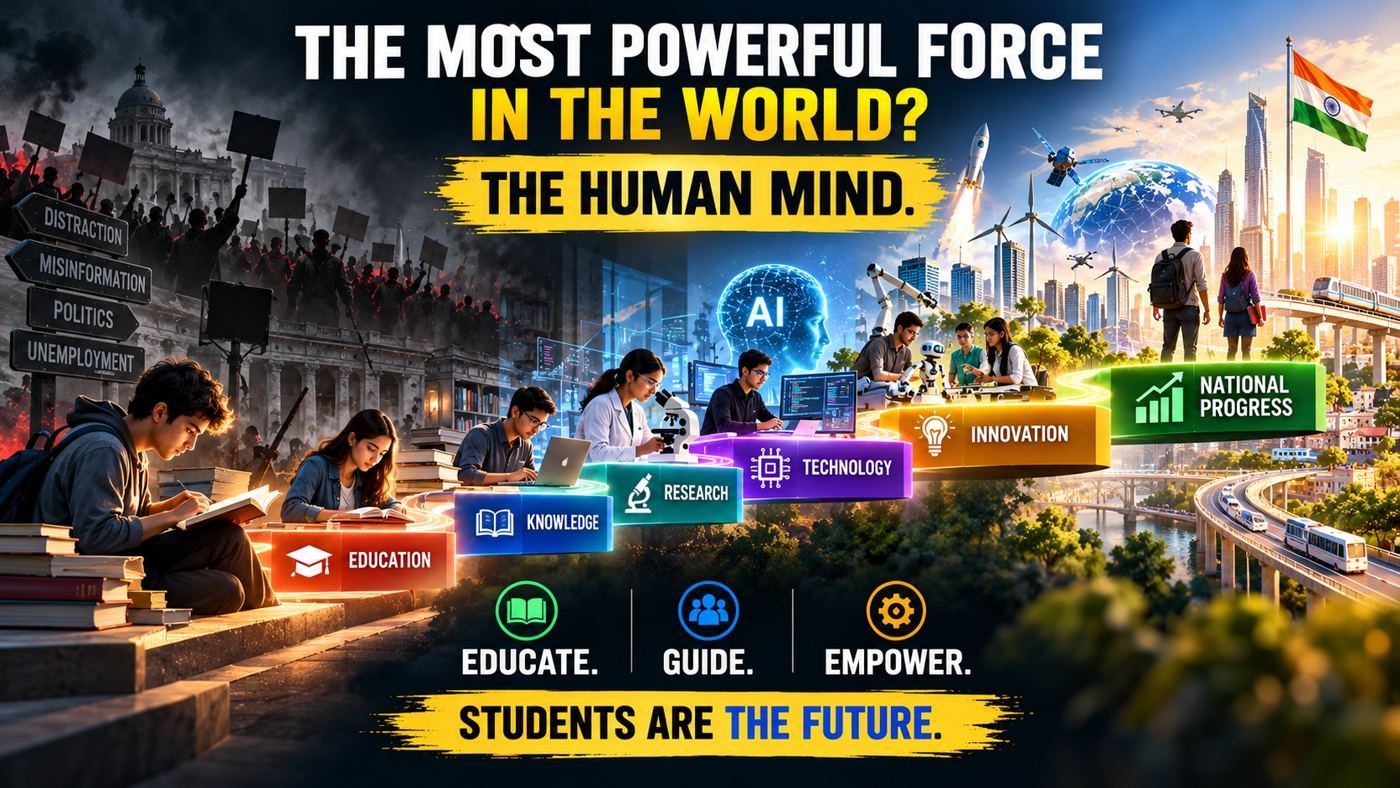
- EducationLiteracy, numeracy and — above all — the habit of curiosity. The foundation everything else stands on.
- KnowledgeNot marks, but understanding: how the world works, and why.
- ResearchAsking questions nobody has answered yet, and testing them honestly.
- TechnologyTurning answers into tools that ordinary people can use.
- InnovationMaking those tools cheaper, better, available to everyone — and creating jobs on the way.
- Economic StrengthA country that sells ideas, not just raw material and cheap labour.
- National ProgressHealthier, safer, freer, more confident citizens. The real meaning of a developed nation.
Notice something: there is no shortcut from step one to step seven. Every country that reached the top climbed every step. And every step is built by minds.
The Choice Before Gen Z
Your generation has more access to knowledge than any generation in human history. A student in a village with a phone can watch a Harvard lecture, learn to code, read a research paper, or build an app. The tools that once belonged to kings and universities now fit in your pocket.
The same phone can also make you angrier, more distracted and easier to manipulate than any generation before you. The device is neutral. The mind holding it is not.
Create, don't destroy
Build something this year — a project, a blog, a prototype, a club.
Learn, don't only react
For every hour of feed, give an hour to a book or a skill.
Argue, don't attack
Win with evidence. Lose gracefully. Learn either way.
Solve, don't only complain
Pick one problem near you. Study it until you understand it. Then try.
Back to That Room at 11:40 PM
The physics chapter is still open. The angry feed is still refreshing. Nothing dramatic happens. She closes the second tab and works through three problems before sleeping.
No one will ever write about that night. But ten years later, when she is designing a cheaper solar cell or running a hospital or teaching a classroom of her own, it will have been one of a thousand quiet nights that decided the direction of her mind — and, in a small way, the direction of her country.
That is how nations are actually built. Not in a single dramatic day, but in millions of ordinary evenings when young people choose to build.
Never stop thinking. Never stop questioning. But after questioning — build. Education is not about filling a mind. It is about giving it a direction.