
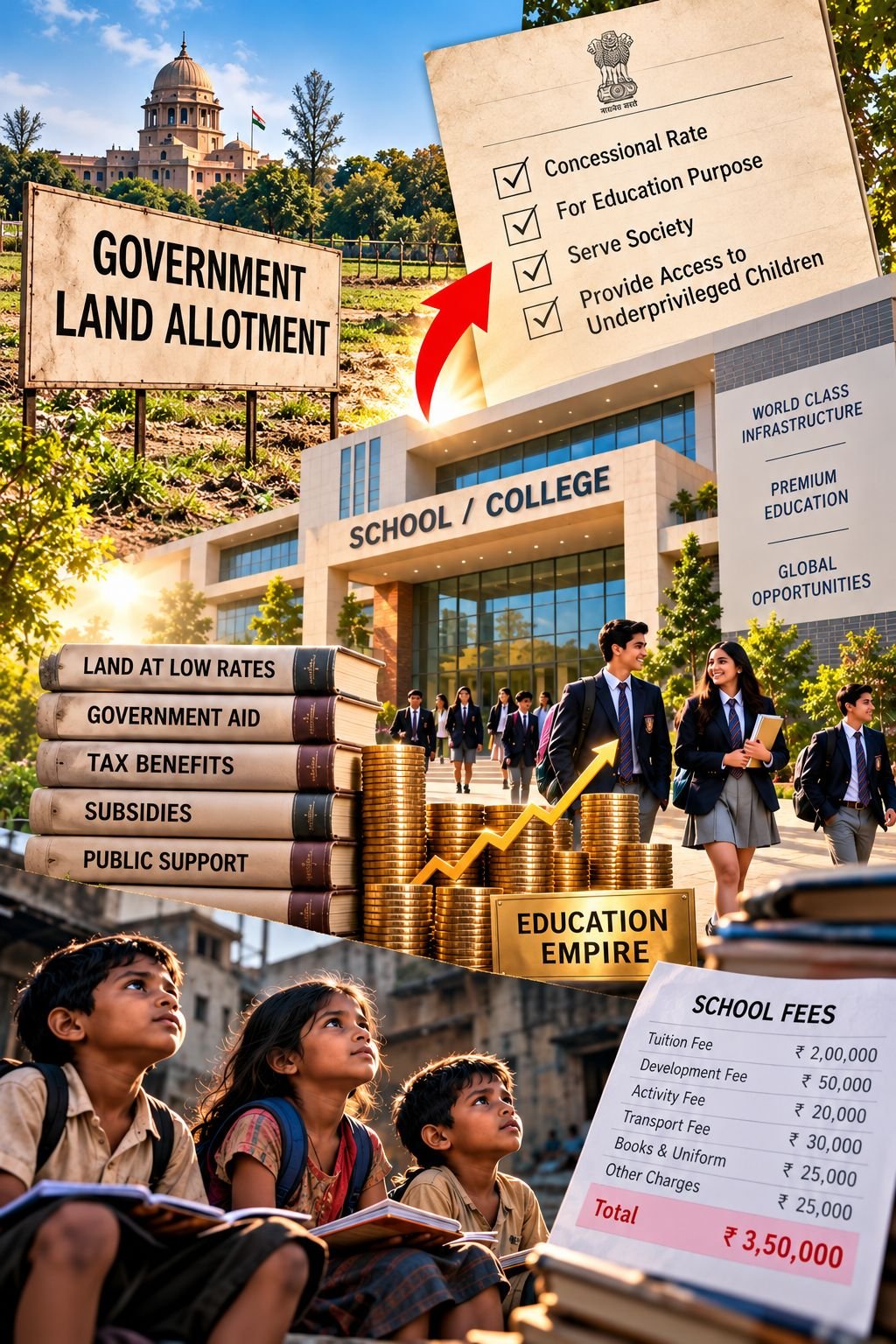
In June 2022, at least fourteen teenagers at one of Delhi's best-known schools received a bill. They had been admitted to Modern School, Barakhamba Road, under the economically weaker section (EWS) quota. Now that they had reached Class 11, they were told to clear first-term dues of about ₹67,835 if they wanted to continue — or to collect a school-leaving certificate.
The school stands on land allotted by a public agency. According to the Delhi government's own Directorate of Education, schools set up on public land have an obligation not to charge EWS and disadvantaged-group students. The department said it was "looking into the issue." The school did not respond to reporters at the time.
That single bill holds the whole question this story asks. When the public gives an institution something valuable — land, tax relief, recognition, a monopoly over a neighbourhood's children — and the institution gives a promise in return, who makes sure the promise is kept?
The Bargain Nobody Reads
Private institutions have a real role in India's education. Governments cannot build every school and college the country needs, and private investment has created world-class campuses, specialised faculty and new courses. Earning a reasonable surplus to sustain and improve an institution is not a crime. It is how institutions survive.
But when a public authority allots valuable urban land at a concessional rate, it is not making a gift. It is making a deal. In Delhi alone, around 400 private schools stand on land allotted by public land-owning agencies such as the Delhi Development Authority (DDA), typically with conditions attached — including free education for EWS children and, in many allotments, prior government approval before any fee increase.
Sources: PTI report on DDA-land schools (June 2022); NSS Comprehensive Modular Survey: Education 2025 (MoSPI); UDISE+ 2024-25; RTE Act 2009, Section 12(1)(c).
Same Bargain, Different Building: The Hospital That Got Land for ₹1
To see what happens when a public bargain is forgotten, look at a case that is not about a school at all — because the logic is exactly the same.
Indraprastha Apollo Hospital and the 15-acre lease
About 15 acres in Sarita Vihar were leased for the hospital at a symbolic rent of ₹1 a month. The condition: free treatment for poor patients equal to one-third of the hospital's beds and 40% of its outpatients. The Delhi High Court found non-compliance back in 2009. In March 2025, a Supreme Court bench of Justices Surya Kant and N. Kotiswar Singh ordered a joint inspection of five years of records — and warned orally that if the poor were not being treated free as the lease required, management could be handed to AIIMS.
free to the poor
owed free care
The price of a ₹1 lease
Five Incidents That Explain the Problem
Headlines about "fee hikes" blur together. These five cases, from three states and three different courts and departments, show the specific ways a public promise can come under strain — and, just as important, what the system did about it.
Modern School, Barakhamba Road: free seat, then a ₹67,835 bill
At least 14 EWS-quota students were asked to pay Class 11 first-term dues of about ₹67,835. The school sits on public land given on the condition of free education for EWS children. The Directorate of Education said such schools cannot charge EWS and disadvantaged-group students and that it was examining the matter.
DPS Dwarka: children confined to a library over unpaid fee increases
Parents alleged the school had raised monthly fees without departmental approval and used coercive tactics to collect them. On 16 April 2025, the Delhi High Court ordered that students removed over fee disputes be readmitted and barred the school from confining them to the library or cutting them off from classes and classmates. A Directorate of Education inspection on 13 May found irregularities, and the DoE ordered the immediate reinstatement of 32 students. "No child should suffer because of the difference in payment of fee," the order said. The school, for its part, reportedly said it had lost ₹49 crore the previous year.
A ₹3.2 lakh pre-primary year — and a law stuck in the cabinet
Parents protesting at two Hyderabad Public School campuses said fees at one had risen nearly 141% over four to five years, while pre-primary fees at another were about ₹3.2 lakh a year for three to four hours of daily schooling, before transport and books. (One campus publicly called the 140% figure "misleading.") Telangana's proposed fee law — which would categorise schools and tie fee revisions to inflation — had been pending for roughly two years.
Lucknow Public School, Eldeco: "admit first, argue later"
A child from a disadvantaged family was allotted a seat by the state's RTE lottery for 2024-25. The school refused, citing doubts about eligibility. The Allahabad High Court ordered admission; the Supreme Court bench of Justices P.S. Narasimha and Alok Aradhe dismissed the school's appeal. Schools, it held, cannot sit in judgment over a state allotment: they may file a representation, but they must admit the child without waiting for the outcome. The right to education, the Court warned, "will remain an empty promise if the mandate of the RTE Act, 2009, is not worked out in its letter and spirit."
The other side of the ledger: ₹800 crore the state owes schools
Accountability runs both ways. Private schools in Madhya Pradesh were reported to be awaiting about ₹800 crore in RTE reimbursements for 2024-25 and 2025-26. Union Education Ministry records show the state reimbursed around 20,900 private unaided schools for 7.09 lakh RTE children in 2024-25. Similar disputes have reached the Madras and Bombay High Courts.
Sources: PTI via Careers360 (June 2022); Delhi High Court order of 16 April 2025 (SCC Online); DoE order via PTI/The Week (May 2025); Deccan Chronicle and Siasat (March–April 2026); Supreme Court, Lucknow Public School, Eldico v. State of UP, 2026 INSC 422; Free Press Journal (September 2026).
Follow the Money: What Families Actually Pay
For a family with a high income, a private school bill is an expense. For a family on a modest salary, the same bill decides which school a child can dream of. The government's own national survey — the NSS Comprehensive Modular Survey on Education, released in August 2025 — puts numbers on the gap.
Average annual household spending per student (₹)
Source: MoSPI, NSS Comprehensive Modular Survey: Education 2025 (PIB, 26 August 2025). Bars scaled to ₹45,000 = full width. Averages include all levels from pre-primary to higher secondary; premium schools charge many times more.
Averages hide the top of the market. Here is what the same survey says about who carries the burden:
funded by family
Who pays for a child's schooling?
What one fee means to two families
Consider two households in the same city. The children are equally talented. The fee slip is the same. The difference is what share of the family's income it consumes. The chart below is illustrative: it takes a household earning ₹25,000 a month (₹3 lakh a year) and measures each type of school bill against it.
Fee figures: NSS CMS: Education 2025; Hyderabad pre-primary fee as reported by Deccan Chronicle (2026). Household income of ₹3 lakh is a hypothetical benchmark chosen by CampusNewz for illustration.
The Fee Ladder: How Fast Bills Are Climbing
The problem is not only the size of the fee. It is the speed of the increase, and the fact that a parent with a child already in Class 4 cannot easily walk away. A LocalCircles survey reported in mid-2025 found that more than 80% of parents with children in private schools said fees had risen by over 10% in a single year.
parents report
>10% hike in a year
One year, one survey
Reported fee increases, as described by parents and media
Sources: Deccan Chronicle (Hyderabad, March 2026); The Daily Ittefaq / wire reporting on Delhi families (June 2025); UNI (Punjab, August 2026). Bars scaled to 150% = full width. Parent-reported figures are allegations, not audited findings.
Where India's Children Study — and Where They Are Moving
This matters more every year, because more families are paying. According to UDISE+ 2024-25, private unaided schools now hold the highest share of enrolment ever recorded, while the government share has dipped below half for the first time.
croreschool students
2024-25
Share of enrolment by school management
Source: UDISE+ reports, compiled by educationforallinindia.com. NSS household data (2025) gives a higher government share of 55.9% because it is based on a household survey rather than school records.
The direction is clear. As private schooling becomes the default for more families, the terms on which private schools operate — what they charge, whom they admit, what they owe the public — stop being a niche concern of elite parents in South Delhi. They become a question about nearly half the country's children.
What the Law Already Promises
India is not short of law on this subject. It is short of enforcement. The protections already on the books are substantial:
Sources: Supreme Court and Delhi High Court judgments (Indian Kanoon, SCC Online, LiveLaw); Delhi Gazette, 14 August 2025; NMC office memorandum, February 2022; Dinamalar (January 2026); UNI (August 2026); Free Press Journal on Rajya Sabha Q. 2765 (August 2026).
The RTE quota in practice
The 25% quota is not a dead letter. In Delhi's second lottery for 2026-27 alone, 8,976 children were allotted seats in nursery, KG and Class 1 at private unaided schools. In Tamil Nadu, 70,449 children were admitted under the quota across 7,717 private schools in 2025-26. But the number of participating Tamil Nadu schools has fallen from 8,613 in 2020-21. And an Indus Action study based on a survey of over 10,000 people, reported in 2019, found that more than 80% of Delhi's private schools were not fully implementing the law.
Source: Directorate of Education, Delhi, via Careers360 (July 2026). Includes EWS/DG and children with special needs (CWSN). A seat allotted is not yet a seat taken — the Lucknow case shows why.
Tax Exemption Is Not an Unconditional Privilege
Many educational trusts and societies enjoy income-tax exemption because, in Indian law, education is treated as charity. In October 2022, a three-judge Supreme Court bench led by then Chief Justice U.U. Lalit tightened what that means. An institution can earn a surplus in a year, and it can make incidental income from things like textbooks, buses or hostels. But its object must be education solely — not "mainly" or "predominantly."
The practical point for parents: exemption is meant to be tested against audited accounts, not assumed from a trust deed. Where a society is moving surpluses into unrelated businesses, or charging fees that bear no relation to costs, tax authorities have the legal tools to ask questions. Whether they use them is another matter.
Who Regulates What? A State-by-State Snapshot
Because the Centre has said fee regulation belongs to the states, the protection a parent gets depends heavily on where they live.
| State / UT | How fee hikes are controlled | Status |
|---|---|---|
| Delhi | School-level fee committee (management, 3 teachers, 5 parents); 3-year fee blocks; district appeal; fines ₹1–10 lakh | Act in force since Aug 2025; under Supreme Court challenge |
| Punjab | Maximum 5% per session; anything more needs regulator approval | Amendment passed Aug 2026 |
| Tamil Nadu | 7-member committee headed by retired HC judge fixes binding fees for 3 years | Amendment passed Jan 2026 |
| Maharashtra | Up to 15% every two years; review if 25% of parents object | In force |
| Karnataka | Up to 10% a year with audit-based justification | In force; complaints reach child-rights panel |
| Telangana | Proposed: categorise schools, cap fees, link revisions to inflation | Bill pending ~2 years (as of Mar 2026) |
Sources: SCC Online; UNI; Dinamalar; Deccan Chronicle; wire reporting (2025–26). Rules summarised as reported; check the current state notification before acting on them.
Delhi's penalty ladder
Source: Delhi School Education (Transparency in Fixation and Regulation of Fees) Act, 2025, as summarised by SCC Online. Unlawfully collected fees must be refunded within 20 working days of the Director's order.
Beyond Schools: Colleges, Universities and Professional Courses
The same questions follow students to higher education, where costs are genuinely larger: laboratories, hospitals attached to medical colleges, research faculty. Nobody should expect an engineering college to cost the same as a primary school.
But the principle does not change with the size of the campus. Where a college or private university has received concessional land, grants or other public support, the terms should be public. Students deserve to see, before they pay an admission deposit, the difference between tuition, compulsory institutional charges and optional services — and to know whether an advertised scholarship lasts four years or only one.
Medical education shows that regulators can act. The National Medical Commission's 2022 direction that half of all seats in private medical colleges and deemed universities be charged at government-college rates was a recognition that a public resource — a licence to train doctors — carries a public obligation. Implementation has been uneven across states, but the principle is now on record.
Four Seats at the Table
Every fee dispute has at least four parties. Each has a legitimate point. The system fails when only one of them is heard. (The voices below are composites based on the complaints, court filings and statements described in this story, not quotes from named individuals.)
"Just show me why."
"I don't expect the fee to stay the same forever. I expect to be told why it is going up 20% when my salary went up 6%."
Parents have almost no bargaining power once a child is enrolled. Changing schools mid-way costs friendships, continuity and often a fresh admission fee. Transparency is the minimum they are owed.
"Am I still welcome here?"
"In Class 8 nobody knew I was on a free seat. In Class 11 everybody knew, because I was the one called to the office."
The child who enters through the RTE quota did not negotiate the land lease. Whatever the legal grey zones after Class 8, no child should be singled out, held back from class or handed a leaving certificate over a dispute between adults.
"Our costs are real too."
"Teacher salaries, Pay Commission revisions, smart classrooms, security, compliance. And the government is two years late with our RTE money."
Schools have a fair case. Fee regulation that ignores genuine costs will degrade quality, and delayed reimbursements are a government failure, not a school's. Good regulation lets schools prove legitimate expenditure — and approves increases that are justified.
"Our job did not end at the allotment letter."
"We gave the land. We made the rules. We must now be able to show, school by school, that the conditions are being met."
The state is the only party that can audit, publish and enforce. When it issues a notice and then goes silent, it signals to every institution that public conditions are optional.
What CampusNewz Believes Must Change
The answer is not to demand that every school cut its fees, nor to assume every expensive school is profiteering. It is to tie public concessions to obligations that can be seen, measured and enforced.
🗺️ A public register of concessional land
Every state and development authority should publish: institution, land area, allotment price, market value at the time, conditions attached and compliance record.
🔍 Regular audits of public obligations
Check each institution against its own allotment terms — free seats, fee approvals, scholarships — not against a generic checklist.
🧾 Itemised, understandable fees
Tuition, development, activity, transport and "other charges" listed separately, with the reason for any increase, before admission.
⚖️ A grievance system with deadlines
Parents should know where to complain about an unlawful fee, an RTE refusal or a broken land condition — and get a decision within a fixed time.
🛡️ Keep children out of the crossfire
No confinement, no withheld admit cards, no public naming. Fee disputes are between adults and must be settled by adults.
📈 Separate real costs from misuse
Independent financial scrutiny that approves genuine expenditure and flags surpluses diverted away from education.
⏳ Governments must pay on time
Time-bound RTE reimbursement at a published per-child rate, so schools cannot blame the state — and the state cannot hide behind schools.
🏆 Recognise those who honour the deal
Publish and celebrate institutions that fulfil free-seat obligations and run genuine scholarships. Accountability should reward excellence, not only punish failure.
📝 Publish the outcomes, not just the notices
When a regulator investigates a school, parents should be able to see what was found, what was ordered, and whether it was complied with. A show-cause notice without a public outcome changes nothing.
Before You Pay the Next Fee Increase, Ask
Parents are not powerless. In most states the law gives you more rights than schools advertise. Five questions to put in writing:
Was this increase approved — and by whom?
In Delhi, by the school-level fee committee. Elsewhere, by the state fee authority or the school management committee under CBSE bye-laws. Ask for the approval order.
Is the school on public land?
If yes, ask the Directorate of Education or the land agency for the allotment conditions. They may require prior approval for fee hikes and free EWS education.
Which charges are compulsory?
CBSE guidelines bar schools from forcing you to buy books, uniforms or stationery from a particular vendor. Ask for an itemised list.
How many RTE / EWS seats were filled this year?
A school that honours its public obligations should be proud to tell you.
Where do I appeal, and how long will it take?
Note the deadline. Under Delhi's Act, parents have 30 days to appeal a committee decision to the District Fee Appellate Committee.
Back to the Bill
Go back to that fee demand handed to fourteen teenagers in 2022. Whatever its final legal outcome, it exposed something larger than one school: a public condition, attached to public land decades ago, that the families concerned could not easily read, the regulator had to "look into," and the children had to worry about just as they began their senior-secondary years.
India needs strong schools and excellent universities. It needs private investment and philanthropic leadership. It should let institutions earn what they need to pay good teachers and build good labs. None of that is in conflict with a simple rule: when the public helps you build, the public gets to see what it got back.
The real measure of an educational institution is not the scale of its campus, the strength of its brand or the revenue it earns. It is the opportunities it creates, the students it serves and the promises it keeps.
Because when the purpose of education is overshadowed by the pursuit of revenue, the cost is not only a family's fee bill. It is social mobility, equality of opportunity and the future of the country itself.