
From disappointment to distinction: Avni Kejriwal, Class 12 student achieved a flawless 500/500 after CBSE re-evaluation, earning the title of National Topper. VIEW NOW →
Career Guide · India 2026

Civil Administration Stream

Civil
Administration
(IAS · IPS · IFS)

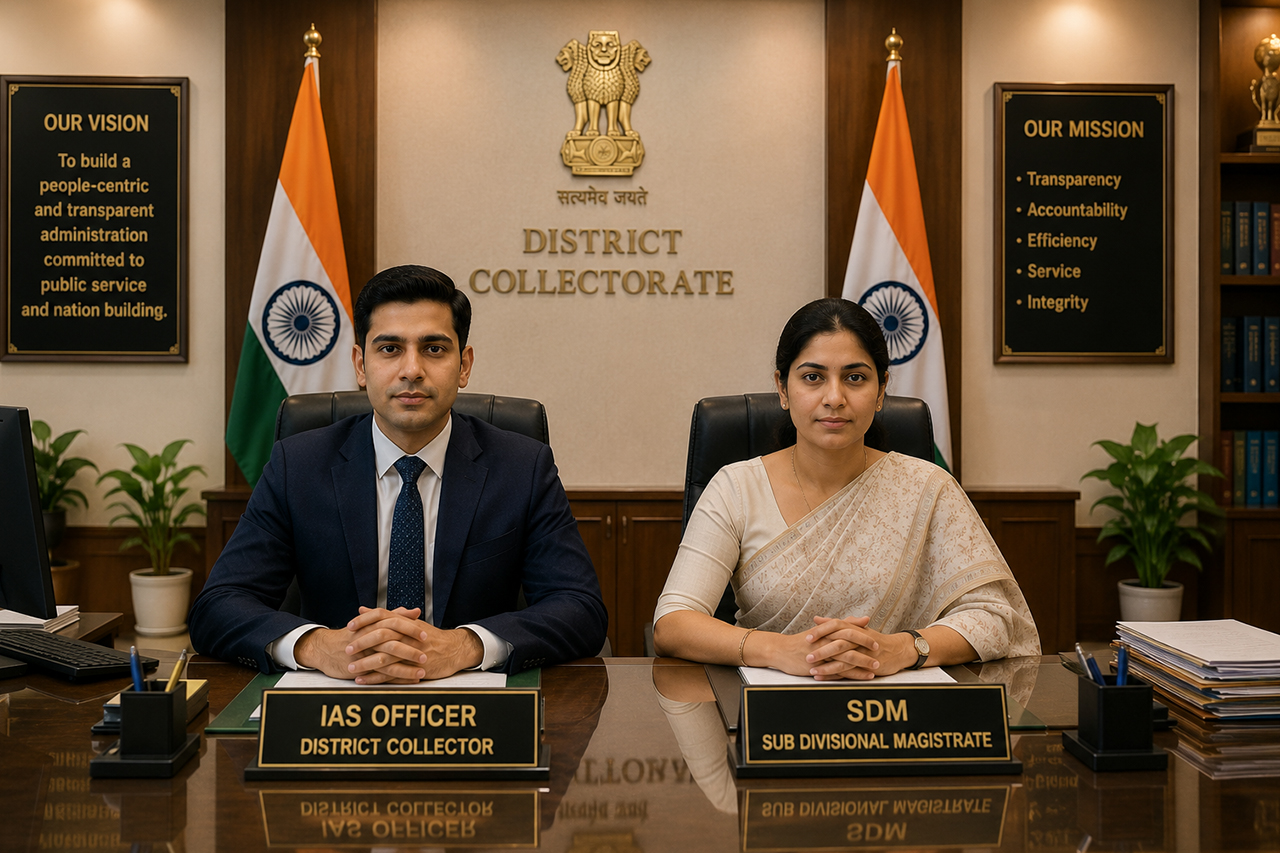
Building the Nation with Vision, Leadership, and Integrity — a career in civil administration places you at the heart of India's governance, public service, and policy-making, empowering you to bring meaningful change at every level of society.
GraduationAny Discipline Eligible
UPSC CSENational Entrance Exam
₹56K+Starting Basic Pay / Month
Any Stream10+2 Stream No Bar
Explore

Overview

What is Civil Administration?

1
Serve the NationCivil servants are agents of change who directly influence people's lives and public welfare on a mass scale.
2
Leadership & AuthorityFrom district governance to national policy formulation, civil servants lead across every sector.
3
Job DiversityPostings in urban, rural, ministries, embassies, and international organizations offer dynamic environments.
4
Respect & Social PrestigeCivil services remain one of India's most respected professions, commanding honour and public trust.
5
Stability & BenefitsJob security, competitive pay, housing, health benefits, and pension — for life.

A career in civil administration is one of the most prestigious and impactful choices in India. It places individuals at the heart of governance, public service, and policy-making, empowering them to bring meaningful change in society. Civil administrators are responsible for the implementation of government policies, maintenance of law and order, revenue administration, development planning, and public welfare initiatives across the country.

Serving through the Indian Administrative Service (IAS), Indian Police Service (IPS), Indian Foreign Service (IFS), and other Central and State Services, these officers play a key role in shaping the social, economic, and political fabric of the nation. The UPSC Civil Services Examination is the gateway to all-India services — and State PSC examinations lead to state-level administrative roles that are equally impactful.

Beyond UPSC, civil administration offers pathways through SSC, Banking, Railways, policy think tanks, NGOs, and academic careers — making it a versatile stream for any graduate committed to governance and public service.

Major Civil Services in India — Recruited via UPSC
IASIndian Administrative Service — Policy implementation, district governance, public service delivery, disaster management. India's premier civil service, the backbone of the country's administrative machinery.
IPSIndian Police Service — Law and order, crime prevention, intelligence, and internal security. IPS officers lead India's state and central police forces at the highest levels.
IFSIndian Foreign Service — Diplomacy, international relations, and representing India at embassies and international organisations worldwide. The face of India on the global stage.
IRSIndian Revenue Service — Tax administration including Income Tax, GST, and Customs. IRS officers manage India's entire tax collection machinery under CBDT and CBIC.
IAASIndian Audit and Accounts Service — Government expenditure auditing and financial accountability under the Comptroller and Auditor General (CAG) of India.
IIS / IDES / ITSIndian Information Service (government media and communications), Indian Defence Estates Service, and Indian Trade Service — specialised central services with unique functional domains.
Career Landscape

Career Opportunities — Starting to Senior

Civil administration opens six distinct career pathways — from India's most prestigious all-India services to policy roles at international organisations. Each pathway offers meaningful public impact alongside structured career progression and government benefits.

🏛️

All India & Central Services (UPSC)

The most prestigious pathway — through UPSC Civil Services Examination (Prelims + Mains + Interview), candidates join IAS, IPS, IFS, IRS, IAAS, and 20+ other Central Group A services. IAS officers govern districts, divisions, and ministries. IPS officers lead law enforcement. IFS officers represent India abroad. The 7th Pay Commission ensures structured pay with Grade Pay, HRA, DA, and full pension benefits.

Entry
₹56K/mo
Mid-Level
₹1.44L/mo
Secretary
₹2.25L+/mo
🏢

State Government Services (State PSC)

State Public Service Commission examinations recruit officers for State Administrative Services, State Police Services, and Revenue Services. Successful candidates become Deputy Collector, Block Development Officer (BDO), Tehsildar, District Employment Officer, Commercial Tax Officer, and Deputy Superintendent of Police (DSP) — driving governance directly at district and taluka level, where policies meet the people.

Starting
₹40K/mo
Mid-Level
₹80K/mo
Senior
₹1.5L+/mo
🏦

Government Sector Jobs (SSC / Banking / Railways)

Staff Selection Commission (CGL, CHSL), Banking sector (IBPS PO, SBI PO, RBI Grade B), and Railways (RRB NTPC, ALP) offer administrative, clerical, and managerial roles with strong government benefits. These competitive examinations provide entry into India's largest employment sector — with postings across every district of India and structured promotions through the ranks.

Starting
₹25K/mo
Mid-Level
₹60K/mo
Senior
₹1.2L+/mo
🌐

Policy & Governance Careers

Professionals work with NITI Aayog, the United Nations Development Programme (UNDP), World Bank, Asian Development Bank, and India's leading policy think tanks such as CPR, IDFC Institute, ORF, and Brookings India. Roles include Policy Analyst, Research Associate, Programme Officer, and Governance Consultant — combining analytical rigour with real-world policy impact at the highest levels of decision-making.

Starting
₹6–10 LPA
Mid-Level
₹15–30 LPA
Senior
₹35–80 LPA+
🤝

NGO & Development Sector

India's development sector — comprising 3.3 million NGOs and major CSR-funded social organisations — employs graduates from civil administration backgrounds for programme management, field coordination, monitoring and evaluation, and policy advocacy. International NGOs such as Oxfam, Save the Children, CRS, and CARE India offer competitive packages. Domestic organisations like Pratham, Akshara, and Smile Foundation work in education, healthcare, and rural development.

Starting
₹4–7 LPA
Mid-Level
₹10–20 LPA
Senior
₹20–40 LPA+
🎓

Academic & Research Careers

Teaching and research in Public Administration, Political Science, Sociology, and Governance offers stable, intellectually rewarding careers. Central Universities, IITs, IIMs (public policy programmes), and state universities recruit faculty through UGC-NET / SET. Higher studies — MA Public Administration, MPA (Master of Public Administration), or PhD — open doors to UPSC Civil Services Board membership, IIPA (Indian Institute of Public Administration) faculty, and international academic roles.

Starting
₹5–8 LPA
Associate
₹10–18 LPA
Professor
₹18–30 LPA+
Career Paths

Popular Career Paths & Job Roles

Civil administration offers a spectrum of roles — from commanding the nation's administration as an IAS officer to representing India on the global stage as an IFS diplomat, managing law enforcement as an IPS officer, or driving tax policy as an IRS officer.

Popular Career Paths
All India Services (IAS / IPS / IFS) Central Services (IRS / IAAS / IIS) State Civil Services (PSC) Revenue & Land Administration Public Policy & Governance Law Enforcement & Internal Security Diplomacy & Foreign Affairs Tax & Revenue Administration Rural & Urban Development Social Welfare & Public Administration
Common Job Roles in India
District Magistrate (DM) / Collector Superintendent of Police (SP) Indian Foreign Service Officer Income Tax Officer / Commissioner Block Development Officer (BDO) Secretary / Joint Secretary Deputy Collector Tehsildar / Revenue Officer Deputy Superintendent of Police (DSP) Policy Analyst (NITI Aayog / Think Tank) Customs & GST Commissioner CAG Audit Officer District Employment Officer
Competencies

Skills You'll Need for Civil Services

Civil services demand a rare combination of intellectual depth, ethical grounding, leadership capacity, and field-level empathy. UPSC's three-stage selection process — Prelims, Mains, and Personality Test — is specifically designed to assess this complete skill set.

Core Technical & Academic Skills
Indian Polity & Constitution (Fundamental Rights, Directive Principles, Union-State Relations, Amendment Procedures, Emergency Provisions)
Indian Economy & Public Finance (GDP, fiscal policy, monetary policy, taxation, budget, economic planning, poverty alleviation schemes)
History, Geography & Environment (Modern Indian history, physical geography, climate, ecology, biodiversity, and environmental governance)
Public Administration & Governance (Administrative structure, e-governance, decentralisation, RTI, accountability mechanisms)
Data Analysis & Report Writing (Statistical interpretation, policy brief writing, analytical report drafting for government use)
Policy Analysis & Legal Awareness (Understanding of laws, acts, court judgements, and their administrative implications)
Current Affairs & International Relations (India's foreign policy, global institutions, bilateral relations, geopolitics, and strategic affairs)
Essay Writing & Comprehensive Answer Writing (UPSC Mains essay paper + General Studies answer writing up to 250 words per answer)
Essential Leadership & Soft Skills
Leadership & Decision-Making (Making sound decisions under uncertainty, managing crises, coordinating multiple departments simultaneously)
Integrity & Ethical Judgment (GS Paper IV — Ethics, Integrity, and Aptitude; case study-based ethical reasoning is a distinct UPSC paper)
Communication Skills (Verbal clarity in Personality Test / Interview; written clarity in Mains; field communication with diverse communities)
Critical Thinking & Problem-Solving (Multidimensional analysis of complex administrative problems; balancing competing interests)
Emotional Intelligence (Empathy in public service, people management, building trust with local communities and stakeholders)
Adaptability & Time Management (Managing multiple priorities; adjusting to frequent transfers across varied postings and environments)
Language Skills (Hindi + English are mandatory; regional language proficiency is advantageous for State PSC and district postings)
Eligibility

Eligibility & Entry Criteria

Civil services are remarkably inclusive — any graduate from any discipline in any stream (Science, Commerce, Arts) is eligible to appear for UPSC Civil Services Examination. The Constitution mandates Indian citizenship for IAS and IPS. UPSC has age relaxations for OBC, SC, ST, and PwBD candidates.

Graduation
Any Discipline — Any University
(Minimum Eligibility)
21–32 Yrs
Age Limit (General)
OBC: +3 | SC/ST: +5 Yrs
6 Attempts
General Category
OBC: 9 | SC/ST: Unlimited
📚 Academic Eligibility
A Bachelor's degree (any discipline) from a UGC-recognised university is the minimum eligibility for UPSC Civil Services Examination — there is no minimum percentage requirement; even a candidate appearing in the final year of graduation is eligible to appear for Prelims (subject to producing degree certificate at Mains stage)
Graduation stream does not matter — Science, Commerce, Arts, Engineering, Medicine, Law, Agriculture — all are eligible; the UPSC optional subject choice (from 48 options) should ideally align with the candidate's academic background for maximum preparation efficiency
For State PSC examinations: eligibility criteria vary by state — most states require a Bachelor's degree; some technical posts (Revenue, Forestry, Engineering) may require specific stream qualifications; check individual state PSC notification for exact requirements
For SSC CGL: Graduation in any discipline; for Banking (IBPS PO/SBI PO): graduation in any discipline + computer literacy; for RBI Grade B: 60% in graduation; specific age and qualification criteria vary by examination — always verify from official notifications
🏛️ UPSC CSE Selection Process
Stage 1 — UPSC Prelims: Two objective papers — GS Paper I (200 marks, 100 questions, Indian history, geography, polity, economy, environment, current affairs) and CSAT Paper II (200 marks, 80 questions, reading comprehension, logical reasoning, basic numeracy) — CSAT is qualifying only (33% required); GS Paper I determines merit for Mains
Stage 2 — UPSC Mains: Nine papers over 5–7 days — 2 language papers (qualifying), Essay (250 marks), GS I-IV (250 marks each), and Optional Subject Papers I & II (250 marks each); total 1,750 marks count towards final merit list; answer writing quality and content depth are decisive
Stage 3 — Personality Test / Interview: 275 marks before the UPSC board; tests intellectual curiosity, balance of judgment, leadership ability, integrity, and general awareness; not a test of knowledge but of overall personality fit for public service; conducted in Hindi or English (candidate's choice)
Final Merit & Service Allocation: Combined Mains + Interview marks determine rank; candidates choose service preference order (IAS, IPS, IFS etc.); service allocation is based on merit rank, vacancy, category, and state cadre allocation; top rankers typically get IAS; IPS usually requires top 200 rank
🎯 Reservation & Relaxations
OBC (Non-Creamy Layer) candidates: age relaxation of 3 years (maximum age 35); 9 attempts allowed; 27% reservation in vacancies; OBC certificate from a competent authority of the state required; NCL OBC certificate must be valid and current at time of application
SC / ST candidates: age relaxation of 5 years (maximum age 37); unlimited attempts; SC: 15% reservation, ST: 7.5% reservation; caste certificate from DC/SDM required; SC/ST candidates have no upper age cap and can attempt as many times as they wish until upper age limit
PwBD (Persons with Benchmark Disability): 10-year age relaxation (General: 42, OBC: 45, SC/ST: 47); 4% horizontal reservation in vacancies; physical standards relaxed for certain services; candidates with locomotor, visual, hearing, and other disabilities are eligible with UDID certificate
Ex-Servicemen: age relaxation of 5 years for Defence services (3 years for OBC ex-servicemen, 8 years for SC/ST ex-servicemen); attempt count: 3 attempts for General category; ex-servicemen receive horizontal reservation in government sector and state PSC examinations
📋 Preparation Strategy
Standard preparation timeline is 12–24 months; Prelims requires 4–6 months of dedicated current affairs + static syllabus study; Mains answer writing practice (minimum 150–200 answers) is the single most critical preparation activity; Ethics GS Paper IV requires a distinct preparation approach with case studies
NCERT books (Class 6–12) across History, Geography, Economy, Polity, and Science are the non-negotiable foundation; standard reference books include Laxmikanth (Polity), Bipin Chandra (Modern History), Ramesh Singh (Economy), and Shankar IAS (Environment)
Optional subject selection is strategic — high-scoring optionals include Geography, History, Public Administration, Sociology, Political Science, Anthropology, and PSIR; candidates with engineering backgrounds often choose Mathematics; literature optionals (Hindi, Telugu, Tamil) are viable for native speakers
Mock interviews (personality test preparation) with former IAS/IPS officers or at coaching institutes are essential for the final stage; IAS coaching institutes in Delhi's Mukherjee Nagar and Rajinder Nagar clusters offer the highest density of civil services preparation resources in India
Entrance Examinations

Key Examinations for Civil Administration

UPSC Civil Services Examination is India's most prestigious and competitive examination — over 10 lakh aspirants appear for Prelims each year, with approximately 1,000 finally selected. State PSC examinations similarly attract hundreds of thousands of applicants for district-level government roles.

Key Insight: UPSC Civil Services 2024 had approximately 10.5 lakh registered candidates for Prelims, with only ~13,000 qualifying for Mains. Approximately 2,800 clear Mains and appear for the Interview. Around 1,016 are finally recommended — a selection rate of approximately 0.1%. Preparation quality, not just duration, determines success.
UPSC CSE

UPSC Civil Services Examination

India's most prestigious examination — conducted by the Union Public Service Commission annually. Three stages: Prelims (objective) → Mains (written) → Personality Test (interview). Leads to IAS, IPS, IFS, IRS, and 20+ other Group A Central Services.

  • Prelims: GS Paper I (100 Qs, 200 marks) + CSAT Paper II (80 Qs, 200 marks — qualifying only); negative marking of 1/3 for wrong answers; typically held in May/June; 10–14 lakh candidates appear
  • Mains: 9 papers over 5–7 days in September; Essay + GS I, II, III, IV + Optional Paper I & II + 2 language papers (qualifying); 1,750 marks count; approximately 13,000 qualify from Prelims to Mains
  • Personality Test: 275 marks; held January–May; 30–45 minute conversation with a 5-member UPSC board; final merit = Mains + PT; approximately 2,800 candidates interviewed for ~1,000 final selections
  • Training: IAS and IPS officers undergo the prestigious Lal Bahadur Shastri National Academy of Administration (LBSNAA), Mussoorie training; IFS at SSIFS, Delhi; IRS at NADT, Nagpur
Notification
February
Prelims
May – June
Mains
September
Final Result
April – May
STATE PSC

State Public Service Commission Exams

Each of India's 28 states conducts its own Public Service Commission (PSC) examination for recruitment to State Administrative Services (SAS), State Police Services, State Revenue Services, and hundreds of other Class I and Class II state government posts.

  • UPPSC PCS (Uttar Pradesh) — one of India's largest state PSC exams; recruits for Deputy Collector, DSP, BDO, and 40+ posts; 3-stage process (Prelims + Mains + Interview); 3–5 lakh candidates appear annually
  • MPSC (Maharashtra), KPSC (Karnataka), BPSC (Bihar), RPSC (Rajasthan), MPPSC (MP), APPSC (Andhra Pradesh), TNPSC (Tamil Nadu) — each state conducts independent examinations with state-specific syllabus and vacancy patterns
  • State PSC Prelims typically tests General Studies (GS) + State-specific topics (history, geography, culture, economy of that state) — familiarity with state affairs is a significant competitive advantage for domicile candidates
  • State PSC Mains includes Essay + GS Papers + Optional Paper; State PSC interview (called Viva Voce) typically carries 100 marks; total selection process takes 1.5–2.5 years from notification to final posting
Notification
Varies by State
Prelims
State Schedule
Mains
3–6 Mo. Later
Interview
6–12 Mo. Later
SSC / BANKING

SSC, Banking & Central Govt. Exams

The Staff Selection Commission (SSC), banking recruitment boards (IBPS, SBI), and Railway Recruitment Boards (RRB) conduct national-level examinations for lakhs of administrative, managerial, and operational posts in central government departments and PSUs.

  • SSC CGL (Combined Graduate Level) — recruits for Income Tax Inspector, Excise Inspector, Assistant Section Officer, Auditor, and Junior Statistical Officer; highest-paying SSC exam; 3 tiers (Tier I, Tier II computer-based + Tier III descriptive)
  • SSC CHSL (Combined Higher Secondary Level) — for 10+2 pass candidates; recruits LDC, JSA, Data Entry Operator, and Postal Assistant; lower entry point for government administrative career
  • IBPS PO / SBI PO / RBI Grade B — Banking sector recruitment; 3-stage process (Prelims + Mains + Interview); SBI PO is most prestigious banking exam; RBI Grade B officers earn ₹35.15 LPA CTC — competitive with top PSU roles
  • RRB NTPC (Non-Technical Popular Categories) — Railway recruitment for Station Master, Commercial Apprentice, Traffic Assistant, and Junior Account Assistant posts; 2-stage CBT + Document Verification
SSC CGL
Notification
March–April
IBPS PO
Notification
August
SBI PO
Notification
January–February
RBI Grade B
Notification
February–March
UGC-NET / GATE

Research, Academic & PSU Entry

For civil administration graduates pursuing research, teaching, or PSU careers, UGC-NET (for Public Administration, Political Science, Sociology) and GATE (for PSU administrative roles) provide structured entry points into academic and applied research positions.

  • UGC-NET Public Administration / Political Science / Sociology — qualifying earns Junior Research Fellowship (JRF: ₹37,000/month) or eligibility for Assistant Professor positions at central and state universities; twice yearly (June and December); 2-stage paper; net qualifying score varies by subject and category
  • IIPA (Indian Institute of Public Administration) — professional development courses, research fellowships, and diploma programmes in public administration; IIPA alumni network includes serving and retired IAS officers; MPA programme prepares for policy and governance roles
  • PSU recruitment via GATE (Administrative / Management) — organisations like ONGC, NTPC, SAIL, GAIL, and BHEL recruit management trainees through CAT + personal interview; not GATE-based, but MBA from top IIMs/IITs leads to management positions in PSUs with CTC of ₹20–35 LPA
  • UN / International Organisation JPO Programme — Junior Professional Officer (JPO) posts at UNDP, UNICEF, WHO, and World Bank India for graduates with strong academic records; competitive selection; Hindi + English proficiency advantageous for UN positions focused on South Asia
UGC-NET
June &
December
JRF Stipend
₹37,000/mo
Asst. Prof.
₹57,700–
₹98,900/mo
PSU CTC
₹20–35 LPA
Compensation

Salary Prospects — Starting to Senior

Civil services provide structured and attractive remuneration under the 7th Pay Commission — with pay levels, grade pay, House Rent Allowance (HRA), Dearness Allowance (DA), travel allowances, and full pension. Beyond basic pay, perquisites significantly enhance the effective compensation of serving officers.

Starting
₹56K/mo
IAS Entry Level
Junior
₹78K/mo
3–5 Years Service
Mid-Level
₹1.18L/mo
Director / Joint Sec
Senior
₹1.82L/mo
Additional Secretary
Cabinet
₹2.25L/mo
Secretary to Govt.
IAS / IPS / IFS Entry Level (SDM / ASP)₹56,100/mo basic
District Magistrate / SP Level₹78,800–₹1.18L/mo
Commissioner / DIG / Joint Secretary₹1.44L–₹1.82L/mo
Principal Secretary / Additional Secretary₹1.82L–₹2.05L/mo
Secretary to Government of India₹2,25,000/mo (fixed)

💡 Additional Benefits Beyond Basic Pay

  • Government-allotted official residence (Type V–VII bungalows for senior officers) in major cities — market value of government bungalows in Delhi often exceeds ₹10–20 crore; HRA for those without official accommodation is 27% of basic pay (metro cities)
  • Official vehicle with driver (allocated from Sub-Divisional Magistrate level onwards); senior IAS/IPS officers get government cars + fuel; this alone saves ₹50,000–₹1,50,000 annually in personal transport costs
  • Dearness Allowance (DA): currently 50%+ of basic pay — significantly boosts total in-hand salary; DA is revised twice yearly (January and July) linked to CPI inflation index
  • Pension: Defined benefit pension (for pre-2004 recruits) or NPS (National Pension System for post-2004); government contributes 14% of basic pay + DA to NPS corpus; senior officers retire with NPS corpus of ₹1–3 crore+ based on career length
  • CGHS (Central Government Health Scheme): free / subsidised healthcare at empanelled hospitals for officer + entire family; effectively removes all major medical expenses; extensive coverage in all major Indian cities
  • Post-retirement opportunities: Most retired IAS/IPS officers serve on regulatory bodies, tribunals, state PSC, election commissions, UPSC boards, or join policy advisory roles at think tanks — earning ₹2–8 LPA as consultants
Preparation Resources

Top IAS Coaching Institutes in India

Delhi's Mukherjee Nagar and Old Rajinder Nagar clusters house India's most reputed UPSC coaching institutes. South India has a strong network in Bengaluru, Chennai, and Hyderabad — serving lakhs of aspirants from Tamil Nadu, Karnataka, Andhra Pradesh, and Kerala each year.

01
Vajiram & Ravi
New Delhi, Delhi
02
Vision IAS
New Delhi, Delhi
03
Rau's IAS Study Circle
New Delhi, Delhi
04
Drishti IAS
New Delhi, Delhi
05
Forum IAS
New Delhi, Delhi
06
Next IAS
New Delhi, Delhi
07
ALS IAS Academy
New Delhi, Delhi
08
SRIRAM's IAS
New Delhi, Delhi
09
Khan Global Studies (KGS)
New Delhi, Delhi
10
Chanakya IAS Academy
New Delhi, Delhi
11
Plutus IAS
New Delhi, Delhi
12
Yojna IAS
New Delhi, Delhi
13
Elite IAS Academy
New Delhi, Delhi
14
KSG India (Khan Study Group)
New Delhi, Delhi
15
Level Up IAS
New Delhi, Delhi
16
Insights IAS
Bengaluru, Karnataka
17
IASbaba
Bengaluru, Karnataka
18
Shankar IAS Academy
Chennai, Tamil Nadu
19
Officers IAS Academy
Chennai, Tamil Nadu
20
Analog IAS Academy
Hyderabad, Telangana
21
Brain Tree IAS Academy
Hyderabad, Telangana
22
RC Reddy IAS Study Circle
Hyderabad, Telangana
23
Chahal Academy
Multiple Cities, India
24
Clear IAS
Kochi, Kerala
25
Bharat IAS & KAS Coaching Centre
Bengaluru, Karnataka
26
La Excellence IAS Academy
Hyderabad, Telangana
27
Unique IAS Study Circle
Chennai, Tamil Nadu
28
Legacy IAS Academy
Bengaluru, Karnataka
29
Fortune IAS Academy
Thiruvananthapuram, Kerala
30
Achievers IAS Academy
Chennai, Tamil Nadu