
From disappointment to distinction: Avni Kejriwal, Class 12 student achieved a flawless 500/500 after CBSE re-evaluation, earning the title of National Topper. VIEW NOW →
Career Guide · India 2026

Defence Stream

Defence
Services
Army · Navy · IAF

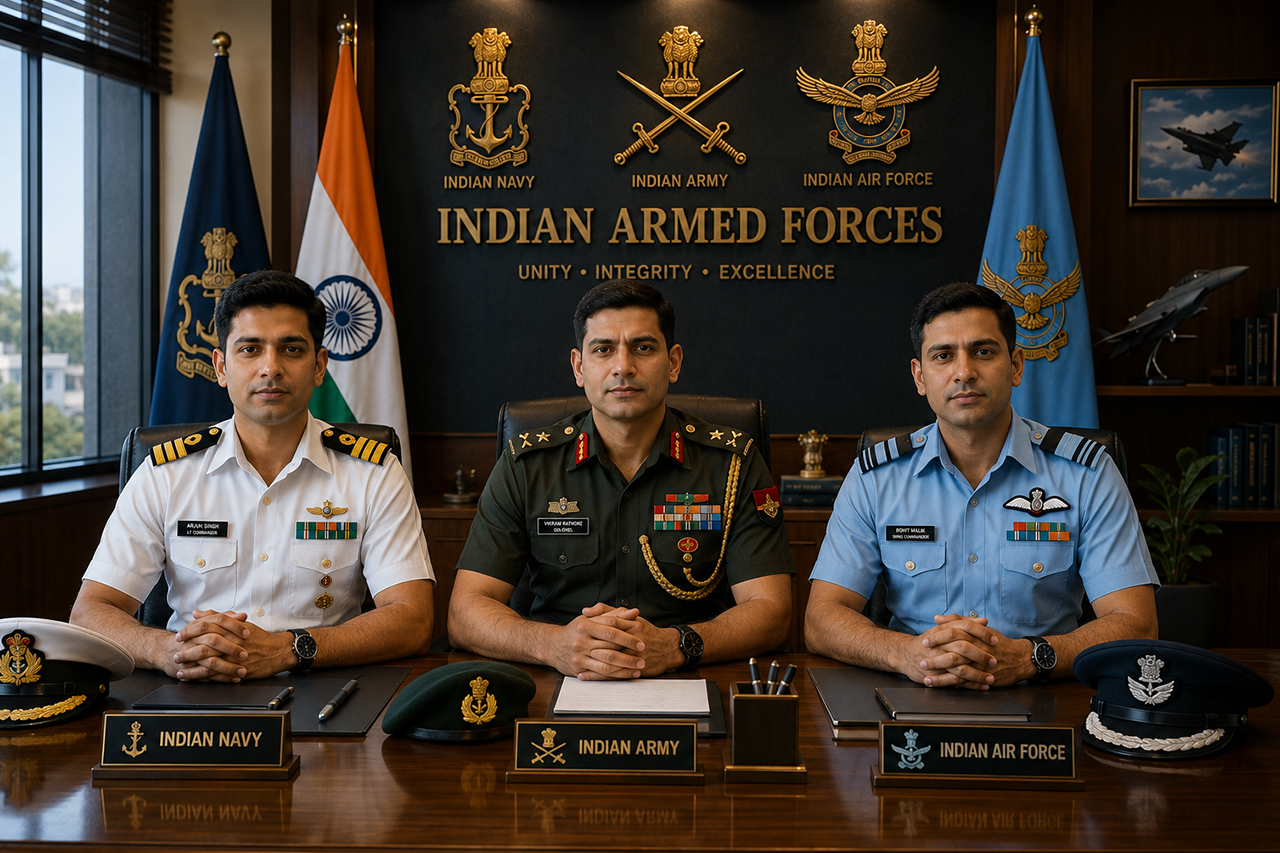
A life of Honour, Courage, and Patriotism — the Indian Armed Forces offer exciting, diverse, and technologically advanced careers to young men and women who aspire to defend the nation with pride, discipline, and unwavering dedication.
Class 12NDA Entry After 10+2
NDA / CDSPrimary Entrance Exams
₹56K+Starting Basic Pay / Month
PCM/AnyNavy/IAF: PCM | Army: Any
Explore

Overview

Why Choose Defence?

1
Service to the NationContributing directly to the security, sovereignty, and unity of India offers unmatched pride and purpose in life.
2
Leadership & AdventureDefence careers groom individuals into leaders through rigorous training, discipline, and real-world responsibilities.
3
Attractive Pay & PerksCompetitive salary under 7th Pay Commission, allowances, free medical, CSD benefits, pension, and housing.
4
Job Security with HonourA stable, respected career with strong post-retirement opportunities in government and private sectors.
5
Growth & EducationOfficers can pursue higher education, advanced training, and international assignments throughout their service.

Choosing a career in defence is not just about a job — it is about dedication to the nation, upholding values of discipline and integrity, and leading a life of courage and leadership. The Indian Armed Forces — comprising the Indian Army, Indian Navy, and Indian Air Force — offer exciting and diverse career opportunities to young men and women who aspire to serve the nation with pride.

With evolving threats and advancements in technology, the defence sector is no longer limited to battlefield roles — it includes cyber warfare, intelligence, engineering, logistics, medical sciences, law, aviation, IT, and space operations. Defence careers combine physical endurance with intellectual challenge, leadership, and unmatched respect in society.

Students can enter Defence Services through various pathways: after Class 12 through NDA (National Defence Academy), after graduation through CDS (Combined Defence Services), or through Technical Entry Schemes (TES), AFCAT, and Short Service Commission (SSC). Beyond the armed forces, opportunities exist in DRDO, the Indian Coast Guard, and paramilitary forces across the country.

Indian Armed Forces & Allied Defence Organisations
Indian ArmyGround-based operations, combat, counter-insurgency, and peacekeeping. Roles span Infantry, Artillery, Armoured Corps, Army Aviation, Corps of Engineers, Signals, Intelligence, and Army Service Corps. India's largest armed force with 1.4 million active personnel across all theatres.
Indian NavyMaritime security, naval operations, submarine command, and ship management. Executive, Technical, Education, and Logistics branches. India's Navy operates aircraft carriers, submarines, destroyers, and is expanding under its 30-year Maritime Capability Perspective Plan.
Indian Air ForceAir combat, transport, surveillance, and technical operations. Fighter pilots, helicopter pilots, transport crew, ground duty officers, engineers, and logistics officers. IAF operates Rafale, Su-30MKI, Tejas, and MiG-29 aircraft with ambitious modernisation underway.
DRDODefence Research and Development Organisation — India's premier R&D body with 52+ laboratories. Scientists and engineers develop missiles (Agni, BrahMos, Prithvi), radars, submarines, tanks, combat aircraft, and advanced materials for the armed forces.
Coast Guard & ParaIndian Coast Guard — maritime law enforcement, search & rescue, anti-smuggling. Paramilitary Forces (CRPF, BSF, CISF, ITBP, SSB, NSG) — internal security, border management, VIP protection, and disaster response across India.
Career Pathways

Entry Routes — Starting to Senior

Defence services offer six distinct entry pathways — each suited to a different educational stage and career aspiration. From the prestigious NDA after Class 12 to DRDO research fellowships for science graduates, every pathway offers structured progression, honour, and national purpose.

🎖️

NDA — National Defence Academy (After Class 12)

India's most prestigious entry into defence — NDA is a tri-service academy in Khadakwasla, Pune. UPSC conducts NDA twice yearly; selected candidates undergo 3-year joint training followed by 1-year service-specific training at IMA Dehradun (Army), NAS Ezhimala (Navy), or AFA Dundigal (IAF). NDA alumni lead India's Armed Forces at the highest levels.

Lieutenant
₹56K/mo
Major/Equiv
₹70K–1.2L
Colonel+
₹1.3L+/mo
🎓

CDS — Combined Defence Services (After Graduation)

CDS is conducted by UPSC twice yearly for graduates — leading to IMA Dehradun (Army PC), OTA Chennai (Army SSC), NAS Ezhimala (Navy), and AFA Dundigal (IAF). CDS offers both Permanent Commission and Short Service Commission routes for men and women officers across all three services.

Lieutenant
₹56K/mo
Major/Equiv
₹85K/mo
Brigadier+
₹1.8L+/mo
⚙️

Technical Entry Schemes (TES / UES / AFCAT)

Engineering graduates and students can enter defence through TES (10+2 PCM direct entry into technical arms), UES (final-year engineering students recruited directly by Army), and AFCAT Technical (IAF entry for engineering graduates into Flying, Technical, Logistics, Administration, and Accounts branches).

Starting
₹56K/mo
Mid-Level
₹80K/mo
Senior
₹1.4L+/mo
⏱️

Short Service Commission (SSC)

SSC provides commissioned officer service for a fixed 10-year tenure (extendable to 14 years). At end of tenure, officers can apply for Permanent Commission based on merit and vacancies — or transition smoothly into civilian careers leveraging their defence leadership experience. Available for men and women in all three services.

Entry
₹56K/mo
Mid-Service
₹70K/mo
Exit/PC
₹1.0L+/mo
🔬

DRDO — Defence Research & Development

DRDO employs scientists and engineers across 52 laboratories working on missiles, submarines, fighter aircraft, radar systems, and advanced materials. Entry via CEPTAM for technical posts and direct Scientist 'B' recruitment for engineering and science postgraduates. DRDO scientists can reach Distinguished Scientist rank (3-star equivalent).

Scientist B
₹56K/mo
Scientist D
₹1.0L/mo
Dist. Sci.
₹2.25L+/mo
🛡️

Coast Guard & Paramilitary Forces

The Indian Coast Guard recruits officers through CGEPT and direct entry schemes. Paramilitary forces — CRPF, BSF, CISF, ITBP, SSB, and NSG — offer Assistant Commandant posts through UPSC CAPF (AC) examination. These forces protect India's borders, internal security, critical infrastructure, and VIP personnel.

Starting
₹44K/mo
Deputy Cmdt
₹78K/mo
DIG+
₹1.44L+/mo
Career Paths

Popular Career Paths & Job Roles

Defence services offer three distinct service streams — Army (ground operations, combat, and administration), Navy (maritime security and naval operations), and Air Force (air combat, transport, and technical operations) — each with its own specialisations, culture, and career trajectory.

Popular Career Paths
Indian Army — Infantry & Combat Indian Army — Engineering & Signals Indian Navy — Executive Branch Indian Navy — Submarine Service Indian Air Force — Fighter Pilot IAF — Ground Duty & Technical Army Aviation Corps DRDO Research & Development Coast Guard — Maritime Security Paramilitary Forces (CRPF / BSF)
Common Job Roles
Army Officer (Infantry / Artillery) Naval Officer (Ship / Submarine) Fighter / Transport Pilot (IAF) Technical Officer (Navy / IAF) Logistics Officer (Army / Navy) Defence Research Scientist (DRDO) Corps of Engineers Officer Signals Officer (IT & Cyber) Army Medical Corps Officer Judge Advocate General (JAG) Intelligence Officer Coast Guard Officer
Competencies

Skills You'll Need for Defence Services

Defence careers demand a unique combination of physical excellence, technical mastery, and exceptional leadership under pressure. The SSB interview is designed to assess 15 Officer Like Qualities (OLQs) — the personality traits that determine an officer's fitness to command.

Core Technical & Military Skills
Military Strategy & Tactical Operations — map reading, battle planning, field operations, counter-insurgency, and peacekeeping doctrine across terrain types
Technical Expertise — Navy & Air Force — aircraft systems, naval systems, avionics, weapon systems, radar, communication systems, and EW equipment operation and maintenance
Physical Fitness & Endurance — sustained performance across PPDT, group tasks, outdoor tasks, running, strength, and obstacle-based assessments during SSB selection
Understanding of Defence Technology — missiles, combat vehicles, naval vessels, electronic warfare, cyber defence, satellite navigation, and space applications for national security
Navigation & Topography — land navigation with map and compass for Army; celestial and electronic navigation for Navy; route planning and coordinate systems for operations
Weapons Handling & Safety — proficiency in service weapons (rifles, LMG, pistol) for officers; advanced weapons training at specialist schools and arms training institutions
Medical & Emergency First Aid — combat casualty care, buddy aid, field first aid, CBRN (Chemical, Biological, Radiological, Nuclear) awareness and protection protocols
Military Communication & Reports — signal procedure, communication systems, SIT reports, operation orders, radio discipline, and secure communication protocols in field environments
Officer Like Qualities (OLQs) — SSB Assessed
Leadership & Effective Intelligence — quick, accurate assessment of situations; guiding team members to solutions under time pressure and uncertainty in real-world scenarios
Courage & Resilience — physical courage in hazardous situations; moral courage to take unpopular decisions; psychological resilience under extreme stress and adversity
Discipline & Integrity — self-discipline in daily life; absolute integrity in actions and communication; adherence to rules and orders without compromise under any circumstance
Quick Decision-Making Under Pressure — making sound decisions rapidly with incomplete information — a core skill tested in all SSB group tasks and individual lecture presentations
Teamwork & Group Cohesion — working effectively in teams; building morale; subordinating personal interests to mission success and group welfare in diverse conditions
Adaptability in Extreme Conditions — maintaining operational effectiveness and decision quality across extreme climate, terrain, fatigue, and high-stress operational environments
Communication Skills — clear verbal orders, written reports, operational briefings — confident, concise, precise communication at all levels of the military chain of command
Eligibility

Eligibility & Entry Criteria

Defence eligibility requirements vary by entry scheme — NDA after Class 12, CDS after graduation, and TES/AFCAT for specific technical and non-technical roles. Physical, medical, and psychological standards are equally important as academic qualifications for defence selection.

16.5–25
Age Range Across
NDA / CDS / SSC Entries
PCM / Any
Navy & IAF: PCM Required
Army: Any Stream
SSB
Services Selection Board
5-Day Personality Assessment
🎖️ NDA — After Class 12
Qualification: 10+2 pass or appearing; PCM mandatory for Indian Navy and Indian Air Force (flying branch); Indian Army accepts all streams (Science, Commerce, Arts) at 10+2 level — most accessible defence entry for non-PCM students aspiring to the armed forces
Age: 16.5 to 19.5 years at the time of commencement of training; only unmarried male candidates eligible for NDA (Army, Navy, AF flying branches); women candidates eligible for NDA from 2022 onwards per Supreme Court judgment — same age criteria
Physical Standards: minimum height 157 cm (Army), 157 cm (Navy), 162.5 cm (IAF flying); weight proportionate to height and age; vision standards most stringent for Air Force pilots (6/6 uncorrected); candidates must not have colour blindness for any branch
Selection Process: UPSC NDA Written Exam (Mathematics 300 marks + General Ability 600 marks) → SSB Interview (5 days, 900 marks) → Medical Examination at AFMS Board → Merit List → Training at NDA Khadakwasla; entire process takes 12–18 months from notification to joining
🎓 CDS — After Graduation
IMA (Indian Military Academy, Dehradun) — Permanent Commission, Indian Army: Bachelor's degree in any discipline; age 19–24 years; unmarried men only; 110 vacancies per course; leads to Permanent Commission as Lieutenant in Indian Army after 1.5-year training programme
OTA (Officers Training Academy, Chennai) — Short Service Commission: Bachelor's degree in any discipline; age 19–25 years; open to both men and women; 10-year SSC with optional extension to 14 years; option to convert to Permanent Commission based on merit and annual vacancies
NAS (Naval Academy, Ezhimala, Kerala) — Indian Navy PC: Engineering/Science degree in specific branches; age 19–22 years; 5-year B.Tech at NAS followed by fleet training; leads to Sub-Lieutenant in Executive or Technical branch of the Indian Navy
AFA (Air Force Academy, Dundigal, Hyderabad) — IAF: Engineering degree with PCM or graduation for Ground Duty; age 19–23 years for Flying, 19–25 for other branches; Permanent Commission; rigorous flying aptitude and medical testing mandatory for pilot selection
⚙️ Technical & Specialist Entries
TES — Technical Entry Scheme (Army): 10+2 with PCM minimum 70% aggregate; age 16.5–19.5 years; join as officer cadets at OTA/IMA for technical arms (Engineers, Signals, EME, ASC, AOC); 4-year degree + officer training leads to Permanent Commission in technical arms
UES — University Entry Scheme (Army): Final-year engineering students from reputed institutions; age up to 24 years; shortlisted candidates appear for SSB in their final year and join after graduation; competitive and prestigious — engineering institutions across India participate
AFCAT — Air Force Common Admission Test: Conducted by IAF twice yearly; Flying: graduation with PCM at 10+2 or engineering; Technical: engineering in specified disciplines; Ground Duty: graduation in relevant disciplines; 3-year Short Service Commission (extendable) for selected candidates
SSB Interview — The 5-Day Selection: Day 1: OIR + PPDT; Day 2: Psychology Tests (TAT, WAT, SRT, SD); Days 3–4: GTO — outdoor tasks, group discussions, command task, FGT; Day 5: Personal Interview; Board Conference — Recommended or Deboarded; overall 20–25% recommendation rate
🏥 Medical & Physical Standards
Physical fitness standards are among the strictest in any Indian career: NDA/CDS physical test includes 1.6 km run in under 8 minutes, push-ups (minimum 20), sit-ups (minimum 20), and chin-ups (minimum 6 for Army); IAF pilots must achieve higher fitness benchmarks including G-tolerance testing
Medical examination conducted by Armed Forces Medical Services (AFMS) Board at designated Military Hospitals; specifies exact height/weight/BMI, blood pressure, vision (uncorrected and corrected), hearing, dental health, flat foot screening, colour vision, and ENT examination requirements
Common medical disqualifications: Colour blindness (all branches); myopia beyond permitted limits (especially pilots); flat foot (Pes Planus Grades II/III); undescended testis; deviated nasal septum; any chronic conditions including asthma, diabetes, epilepsy, or cardiac conditions
Re-medical boards: Candidates declared temporarily unfit (TU) can apply for review at Base Hospital or Air Force Hospital; permanent unfit (PU) cannot apply again in that entry scheme; AFMS review is final authority — candidates should study AFMS medical standards document before applying
Entrance Examinations

Key Exams for Defence Careers

NDA and CDS are conducted by UPSC — India's premier examination body. AFCAT is conducted by the Indian Air Force. All three lead to a 5-day SSB (Services Selection Board) interview — the most comprehensive personality assessment in India's public sector selection process.

Key Insight: The SSB selection rate across NDA, CDS, and AFCAT is approximately 20–25% of candidates who appear for SSB — meaning only about 1 in 4 candidates recommended at SSB will actually get into service after medical boards. SSB preparation focusing on Officer Like Qualities (OLQs), PPDT, GTO tasks, and WAT/TAT psychology testing is the decisive differentiator between candidates.
NDA EXAM

NDA — National Defence Academy Exam

Conducted by UPSC twice yearly (April & September), NDA is India's most competitive after-12th defence entrance — the gateway to becoming an officer in all three services. Approximately 4–5 lakh students appear; only around 400 are finally selected per course after all stages.

  • Written Exam: Mathematics Paper (300 marks, 120 questions) + General Ability Test (600 marks: English 200 + GK 400 covering Physics, Chemistry, History, Geography, General Science, Current Events); total 900 marks; 2.5 hours each paper; negative marking (1/3 per wrong answer)
  • SSB Interview: 5-day personality assessment at SSBs in Allahabad, Bhopal, Bangalore, Coimbatore; tests 15 Officer Like Qualities (OLQs); board includes IO, GTO, and Psychologist; final conference determines recommendation or deboard for each candidate
  • Medical: AFMS Board at designated Military Hospitals; service-specific medical standards (IAF pilots most stringent); approximately 40–50% of recommended SSB candidates fail medical at some stage; thorough medical preparation is strongly advised
  • Training: 3 years at NDA Khadakwasla (joint tri-service academy) + 1 year service-specific training; NDA cadets earn B.Sc./B.Tech degree during training; ranked among Asia's top military training institutions and the only jointly trained tri-service academy in the world
Notification
December & June
Written Exam
April & September
SSB Interviews
Aug–Dec / Jan–May
Joining
January & July
CDS EXAM

CDS — Combined Defence Services Exam

The UPSC CDS examination is conducted twice yearly for graduates entering IMA (Army PC), OTA (Army SSC), NAS (Navy), and AFA (Air Force). CDS is the primary graduate-level entry into commissioned officer service in all three branches of the Indian Armed Forces.

  • Written Exam (IMA/NAS/AFA): English (100 marks) + General Knowledge (100 marks) + Elementary Mathematics (100 marks) = 300 marks; 2 hours each; negative marking; OTA candidates exempt from Mathematics — only English and GK (200 marks) required for Short Service Commission entry
  • Qualifying marks: approximately 40–55% depending on cutoff each year; cleared candidates called for SSB at respective service SSBs; IMA SSBs in Allahabad and Bhopal; NAS SSB in Bangalore; AFA SSB in Mysore and Varanasi for Air Force entry
  • SSB Interview: same 5-day process as NDA SSB; tests identical OLQs; conducted by serving army/navy/air force officers; each service looks for branch-specific aptitude beyond the core OLQs; personal interview with Commanding Officer rank officer
  • Training: IMA — 1.5 years at Dehradun; OTA — 11 months at Chennai; NAS — 5-year B.Tech at Ezhimala; AFA — 74-week (Flying) or shorter (Ground Duty/Technical) training at Dundigal, Hyderabad; Permanent and SSC routes available
Notification
October & June
Written Exam
February & November
SSB Dates
Jul–Dec / Feb–Jun
Joining
January & July
AFCAT

AFCAT — Air Force Common Admission Test

Conducted by the Indian Air Force (IAF) twice yearly, AFCAT recruits men and women for Flying, Technical (Aeronautical Engineering), and Ground Duty (Administration, Logistics, Accounts, Education, Meteorology) branches through Short Service and Permanent Commission routes.

  • AFCAT Written: Online CBT; 100 questions in 2 hours; Verbal Ability in English, Numerical Ability, Reasoning & Military Aptitude, and General Awareness — 300 marks total; minimum qualifying approximately 150 marks; conducted at 300+ exam centres across India
  • EKT (Engineering Knowledge Test): Additional paper for Technical Branch (Aeronautical/Electronics) candidates — 45 questions, 45 minutes; tests engineering fundamentals in Aeronautical, Electronics, or Mechanical engineering; qualifying mandatory for Technical Branch selection
  • AFSB (Air Force Selection Board): 5-day assessment at AFSBs in Dehradun, Mysore, and Varanasi; tests OLQs + Air Force aptitude; includes CPSS (Computerised Pilot Selection System) for Flying Branch candidates — assesses hand-eye coordination, spatial orientation, and multi-tasking
  • Medical: AFMS Board at Air Force hospitals; pilot medical is the most stringent in all armed forces — uncorrected vision 6/6 mandatory for pilots; myopia, astigmatism, colour blindness are disqualifying for flying; technical and ground duty branches have relaxed medical criteria
Notification
October & March
Written CBT
February & August
AFSB Rounds
Mar–Aug / Sep–Jan
Joining
Course-Specific
DRDO / CAPF

DRDO CEPTAM & UPSC CAPF

For defence aspirants targeting research or paramilitary careers, DRDO's CEPTAM and UPSC CAPF (AC) examination are key selection processes — offering stable, prestigious government careers in defence technology and internal security without the mandatory military physical and medical standards of the armed forces.

  • DRDO CEPTAM: Recruits for Technician 'A', Admin & Allied, and Senior Technical Assistant 'B' posts; Scientist 'B' (direct entry for postgraduate engineers/scientists) is the premier DRDO recruitment; 3-stage selection: Tier I (CBT) → Tier II (CBT) → Document Verification
  • UPSC CAPF (AC): Assistant Commandant recruitment for CRPF, BSF, CISF, ITBP, and SSB; Written (General Ability + Essay 250 marks) + Physical Standards Test + Interview/Personality Test (150 marks); graduates in any discipline eligible; age 20–25 years
  • SSC GD Constable: Staff Selection Commission recruits Constables for CRPF, BSF, CISF, ITBP, SSB, NIA, SSF, and Rifleman AR; 10+2 pass required; Physical Efficiency Test + Physical Standards Test + Medical; starting pay ₹21,700/month (Level 3, 7th CPC)
  • Indian Coast Guard Navik & Yantrik: 10+2 with PCM for Navik DB and Yantrik; selection via CGEPT written test + physical fitness test + medical; Navik starting salary ₹21,700/month + maritime allowances; unique maritime career with Search & Rescue operations
DRDO CEPTAM
Annual Notification
CAPF (AC)
Aug Prelims / Nov Mains
SSC GD
Oct–November
Coast Guard
Quarterly Notifications
Compensation

Salary Prospects — Starting to Senior

Defence services provide structured pay under the 7th Pay Commission Military Service Pay (MSP) structure — with additional allowances for field postings, high altitude, Siachen, flight pay, diving allowance, and sea pay that significantly enhance effective compensation beyond the basic pay figures.

Starting
₹56K/mo
Lieutenant
Junior
₹70K/mo
Captain / Equiv
Mid-Level
₹1.0L+/mo
Major / Equiv
Senior
₹1.5L+/mo
Colonel / Equiv
Top Rank
₹2.5L+/mo
Lt. General+
Lieutenant / Flying Officer / Sub-Lt.₹56,100/mo basic
Captain / Flight Lt. / Lt. Commander₹61,300–70,000/mo
Major / Squadron Leader / Commander₹70,000–1,20,000/mo
Colonel / Group Captain / Commodore₹1,30,000–2,00,000/mo
Lt. General / Air Marshal / Vice Admiral₹2,00,000–2,50,000/mo

Benefits & Allowances Beyond Basic Pay

  • Military Service Pay (MSP): ₹15,500/month for all Commissioned Officers across all ranks and services — flat amount over and above basic pay, exclusive to the armed forces, not part of basic pay for pension calculation
  • Free accommodation: Type II to Type V quarters provided at all postings; senior officers get bungalows; bachelor SOQ for single postings; entitled accommodation effectively adds ₹20,000–₹80,000/month in housing benefit at metro stations
  • Operational allowances: Field Area Allowance, Siachen Allowance (₹31,500/month additional), High Altitude Allowance, Flying Pay (₹25,000/month for IAF pilots), Diving Allowance, Sea Pay — significantly boost in-hand salary at operational postings
  • CSD (Canteen Stores Department): subsidised consumer goods, electronics, vehicles, and food for armed forces personnel and veterans; annual savings of ₹50,000–₹1,50,000 for an average officer family at current prices
  • ECHS (Ex-Servicemen Contributory Health Scheme): free/subsidised healthcare at empanelled hospitals for veterans and dependents; Military Station hospitals for serving personnel — family medical bills essentially zero throughout service life
  • Pension: Defence pension is among the most generous in Government of India service; officers with 20+ years qualify for full pension; Disability pension for service-connected injuries; Veer Nari (war widow) pension and gallantry award annuities provide additional security
Preparation Resources

Top Defence Coaching Institutes in India

Defence coaching institutes prepare students for NDA, CDS, AFCAT, and SSB interviews — covering written examination content, physical training guidance, and SSB personality test preparation. Lucknow, Delhi, Dehradun, and Chandigarh are the most concentrated clusters of defence coaching institutes in India.

01
Centurion Defence Academy
Lucknow, Uttar Pradesh
02
Cavalier India
New Delhi, Delhi
03
Minerva Academy
Mohali, Punjab
04
Chanakya Defence Group
Chandigarh, Chandigarh
05
Major Kalshi Classes
Prayagraj, Uttar Pradesh
06
Baalnoi Academy
New Delhi, Delhi
07
Olive Greens Institute
Chandigarh, Chandigarh
08
Target Defence Academy
Lucknow, Uttar Pradesh
09
Doon Defence Academy
Dehradun, Uttarakhand
10
GS Defence Academy
Dehradun, Uttarakhand
11
Nation Defence Academy
New Delhi, Delhi
12
KD Defence Academy
Lucknow, Uttar Pradesh
13
Shield Defence Academy
Lucknow, Uttar Pradesh
14
Force Defence Academy
Indore, Madhya Pradesh
15
Dignitary Defence Academy
Pune, Maharashtra
16
Aim Defence Academy
Ahmedabad, Gujarat
17
Invicta Defence Academy
New Delhi, Delhi
18
CDS Academy
Ambala, Haryana
19
Motions Defence Academy
Jaipur, Rajasthan
20
Lakshya Defence Academy
Ahmedabad, Gujarat
21
Hind Defence Academy
Patna, Bihar
22
Pathfinder Academy
New Delhi, Delhi
23
Tara Institute Defence Wing
New Delhi, Delhi
24
Impact Academy
Hyderabad, Telangana
25
Universal Coaching Centre
Bengaluru, Karnataka
26
Plutus Academy Defence Division
Noida, Uttar Pradesh
27
Defence Guru
Dehradun, Uttarakhand
28
Shoorveer Defence Academy
Lucknow, Uttar Pradesh
29
Success Mantra Defence Academy
New Delhi, Delhi
30
Paramount Defence Academy
New Delhi, Delhi