
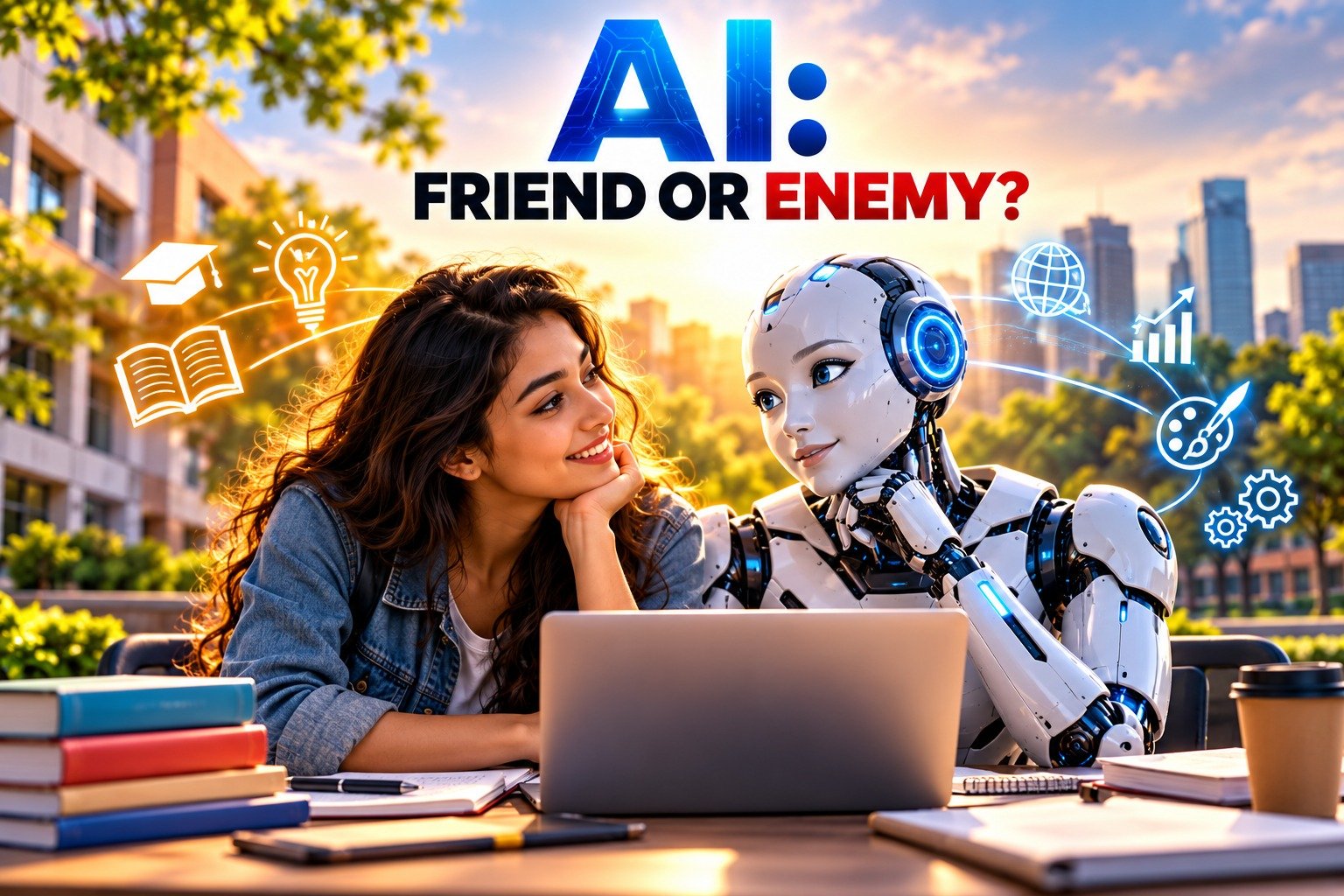
Artificial Intelligence is no longer a technology of the future. It is already a part of our everyday life. The real question is not whether AI will replace humans, but whether humans will learn how to work intelligently with AI.
For centuries, human beings have created machines to make life easier. The wheel reduced physical effort. The printing press transformed knowledge. Electricity changed industries. Computers changed offices. The internet changed communication. Now Artificial Intelligence is bringing another transformation — perhaps one of the most powerful transformations humanity has ever experienced.
AI can write, analyse, translate, calculate, design, summarise, code, generate images, assist research, analyse enormous quantities of information and help people solve problems in seconds. But with every technological revolution comes anxiety. Over the past year, one statement has become increasingly common across industries: "AI is taking our jobs."
Researchers who spend years studying a subject worry that AI can summarise thousands of papers in minutes. Journalists and editorial teams see AI producing articles, headlines and summaries almost instantly. Designers see AI generating artwork in seconds. Publishers wonder how long traditional production models can survive. Programmers are using AI to generate code. Manufacturers are automating processes. Advertisers are using AI to create campaigns. Filmmakers are experimenting with AI-generated characters, voices and visual effects.
And now the discussion has entered classrooms. A school student can ask AI to explain a difficult chapter. A college student can ask it to help structure a project. A postgraduate student can use it to understand complicated research papers. Even PhD scholars are experimenting with AI for literature reviews, data analysis, coding and research assistance. AI is everywhere.
The answer may lie somewhere between the two. AI should neither be blindly worshipped nor blindly rejected. It should be treated as a powerful tool.
The Machine Is Fast. Human Judgment Is Still Essential
One of the greatest advantages of AI is speed. A human researcher may spend hours searching for information; AI can help organise information within seconds. A student may struggle for hours to understand a mathematical concept; AI can explain it in different ways. A teacher preparing a lesson plan can use AI to develop examples, activities and questions.
An engineer can use AI to examine possible solutions. A doctor can use AI-assisted systems to support analysis of medical information. A business analyst can examine large datasets more efficiently. A manufacturer can use AI for predictive maintenance and quality control. A household user can use AI to plan meals, organise schedules, translate languages or learn a new skill.
But speed is not the same as truth. This is where society must become careful. AI can produce an impressive answer that may contain errors. It can misunderstand a question. It can rely on incomplete information. It can present an uncertain statement confidently.
The most important skill of the AI age may not be knowing how to ask AI a question. It may be knowing how to question the answer.
— Dr. Sachin Gupta, Chancellor, Sanskriti University, MathuraIs AI Credible?
This is one of the biggest questions facing students, professionals and society. If AI provides an answer, should we simply accept it? No. AI can be extremely useful, but its output should be evaluated according to the importance of the task.
If a student asks, "Explain photosynthesis in simple language," AI can provide an excellent starting point. But if a student asks, "Who discovered this scientific principle?" the answer should be checked against reliable academic sources. If a researcher asks AI to summarise scientific literature, the original research papers should still be consulted. If a journalist receives a claim from AI, it should be independently verified. If a doctor uses an AI-assisted medical system, professional medical judgment remains essential. If an engineer uses AI to propose a design, safety standards and engineering validation cannot be skipped.
AI and Students: A Personal Academic Assistant
Perhaps nowhere is the AI revolution more visible than among students. From school children to university students, AI is becoming an academic companion. Imagine a student struggling with algebra. Instead of simply giving the answer, AI can explain the problem step by step.
A student studying history can ask: "Explain the causes of the Industrial Revolution in simple language." A science student can ask for an explanation of a complicated concept. A commerce student can request examples to understand accounting. An engineering student can use AI to understand programming concepts. A medical student can use AI to organise revision topics. A language student can practise writing and translation.
This can make education more personalised. A classroom teacher may have 40 or 50 students, each with different learning speeds. AI can provide additional explanations to students who need them.
But there is a serious danger. Students must not allow AI to think for them. If AI writes every assignment, solves every problem and prepares every project, the student may receive a good-looking submission but lose the opportunity to develop knowledge. Education is not merely about producing answers. Education is about learning how to find answers.
AI as a Tutor
- Explains a concept step by step
- Generates practice questions and mock exams
- Points out where your answer went wrong
- Summarises before you read the original
- You stay the owner of the learning
AI as a Shortcut
- Writes the whole assignment
- Solves every problem without explanation
- Prepares the full project
- Replaces reading the source altogether
- Good-looking submission, little real learning
How Students Can Use AI Responsibly
AI can become a powerful academic tool when students use it as a tutor rather than a shortcut. Students can use AI to:
- Explain difficult concepts
- Create revision notes
- Generate practice questions
- Develop quizzes
- Create study plans
- Explain maths mistakes
- Understand programming
- Brainstorm project ideas
- Structure presentations
- Improve grammar & writing
- Translate difficult passages
- Compare theories
- Prepare interview questions
- Develop debate topics
- Generate classroom examples
- Summarise before reading the source
- Identify areas for deeper research
- Practise viva questions & mock exams
But the student should remain the owner of the learning process.
The data shows why this matters. The Digital Education Council's 2026 global survey found that while 88% of students use AI, only 29% believe their instructors are equipped to guide them, and 57% say they get inadequate guidance on AI in assessments. More than one in five students (22%) say they now find it harder to work without AI.
AI and Researchers: Assistant, Not Author
For researchers, AI could become one of the most valuable productivity tools ever developed. Research involves enormous amounts of information. Scientists may need to examine thousands of publications. AI can help identify themes, organise literature, compare findings, extract patterns and assist with data analysis. It can help researchers formulate questions and identify possible research directions.
But research cannot be reduced to generating text. Scientific research requires observation, methodology, experimentation, evidence, reproducibility and critical thinking. An AI-generated research reference that does not exist can be disastrous. Therefore, researchers must verify citations, original papers, datasets and claims.
AI can help a scientist travel faster through the forest of information. But the scientist must decide which path is real.
The Editorial World Is Also Changing
Journalism and publishing are experiencing a major transformation. AI can generate headlines, summaries, social media captions, translations and initial drafts. For news organisations operating under intense deadlines, this can save considerable time.
But journalism has responsibilities that go beyond writing. A journalist must ask: Is the information true? Who said it? What is the evidence? Is the source credible? What context is missing? Could publication harm someone unfairly? AI cannot replace editorial responsibility.
A machine can produce 1,000 words. That does not automatically make those 1,000 words journalism. Good journalism requires judgment, verification and accountability. The future newsroom may therefore not be "AI versus journalists." It may be: Journalists + AI.
Designers, Creators and Filmmakers
The creative industries are facing perhaps the most emotional debate about AI. AI can now generate images, illustrations, video concepts, scripts, music ideas and advertising concepts. A designer may fear that clients will ask: "Why should we pay a designer when AI can make an image in seconds?"
But creating an image is not necessarily the same as creating an effective communication strategy. A creative professional understands audience, emotion, branding, culture, composition and context. AI can generate possibilities. The human decides which possibility matters.
A filmmaker can use AI for storyboarding. An advertising agency can use it for brainstorming. A designer can explore multiple visual directions before creating the final design. A writer can use AI to test different structures. The danger begins when creativity becomes completely dependent on generated content. If everyone uses the same machine-generated patterns, originality may become even more valuable.
AI in Manufacturing
Manufacturing may be one of the sectors where AI produces enormous practical benefits. AI can help factories identify equipment problems before machines fail. It can assist quality inspection, analyse production data, improve supply-chain planning and help reduce waste. Robotics combined with AI can perform repetitive or dangerous tasks.
But automation also creates anxiety among workers. Some jobs will change. Some repetitive roles may disappear. New roles will emerge. The answer cannot simply be to stop technology. Instead, industries and governments must invest in reskilling and upskilling workers. The future worker may need to know how to operate alongside intelligent machines.
AI and Medicine
Few areas demonstrate both the promise and responsibility of AI more clearly than medicine. AI can assist in analysing medical images, identifying patterns, organising patient information and supporting clinical decision-making. It can help researchers discover potential drug candidates, assist hospitals with administrative work and support personalised healthcare research.
But medicine cannot be reduced to an algorithm. A patient is not simply a dataset. Doctors understand symptoms, history, behaviour, emotions and context. AI may provide an additional perspective. The doctor remains responsible for understanding the patient and making appropriate clinical decisions.
AI and Engineering
Engineers are increasingly using AI for design optimisation, simulation, coding and problem-solving. An engineer working on a bridge, aircraft, automobile, building or industrial system can use computational tools to evaluate multiple possibilities. AI can help detect patterns that humans might miss.
But engineering is built on safety. A computer-generated solution cannot simply be accepted because it looks mathematically impressive. It must be tested. It must meet standards. It must be validated. Human engineering judgment remains essential.
AI and Economics
Economists and financial professionals deal with enormous quantities of information. AI can analyse market trends, economic indicators, consumer behaviour and large datasets. Governments can potentially use AI to improve public-service planning. Businesses can analyse demand and supply. Researchers can model scenarios.
But economic forecasting is inherently uncertain. AI can analyse historical patterns; it cannot guarantee the future. Markets are influenced by human behaviour, politics, unexpected events, natural disasters, technological changes and countless other variables. AI should therefore help economists examine possibilities — not pretend to predict everything.
AI and Education: Teachers Will Matter More, Not Less
There is a common fear that AI will replace teachers. But education is not simply information delivery. A teacher does more than explain a chapter. A teacher motivates. A teacher observes. A teacher understands when a student is confused. A teacher recognises confidence and insecurity. A teacher encourages discipline. A teacher teaches values. A teacher can inspire a student to believe in themselves.
AI can provide information. Teachers provide human connection. The classroom of the future may therefore include AI, but teachers will remain central to the development of young people.
AI Inside Our Homes
The AI revolution is not limited to laboratories and corporations. It is entering homes. People can use AI to plan travel, organise schedules, learn languages, prepare shopping lists, understand documents, develop recipes, write letters, learn new skills and solve everyday problems.
A homemaker can use AI to organise household planning. A parent can use it to find age-appropriate educational activities. A senior citizen can use AI to simplify complex digital information. A small business owner can use it to draft advertisements or organise customer information. The technology becomes valuable when it reduces unnecessary effort and gives people more time for meaningful activities.
AI and Defence: Power Requires Responsibility
AI is also becoming relevant to defence and national security. It can assist with intelligence analysis, logistics, surveillance, cybersecurity, simulation and decision-support systems. This area requires extraordinary caution. Technology that can protect lives can also create serious risks if misused.
The development and deployment of AI in defence therefore require strong human oversight, legal frameworks, ethical standards and accountability. The more powerful the technology becomes, the more important responsible human control becomes.
At a Glance: Where AI Helps — and Where Humans Must Stay in Charge
| Sector | AI can assist with | Humans remain responsible for |
|---|---|---|
| 🎓 Students | Explanations, practice, revision plans | Thinking, learning, original work |
| 🔬 Research | Literature mapping, patterns, data analysis | Methodology, evidence, verified citations |
| 📰 Newsrooms | Headlines, summaries, translations, drafts | Truth, sources, context, accountability |
| 🎨 Creative | Concepts, storyboards, visual directions | Choosing what matters; originality |
| 🏭 Manufacturing | Predictive maintenance, quality inspection | Reskilling workers; safe operations |
| 🩺 Medicine | Imaging analysis, patient data, drug discovery | Clinical decisions; the patient as a person |
| 🏗 Engineering | Design optimisation, simulation, coding | Testing, standards, validation |
| 📈 Economics | Trends, indicators, scenario models | Judging uncertainty; not over-predicting |
| 🏫 Teaching | Lesson plans, activities, examples | Motivation, values, human connection |
| 🛡 Defence | Logistics, cybersecurity, simulation | Oversight, law, ethics, accountability |
Will AI Take Our Jobs?
Some jobs will undoubtedly change. Some tasks will be automated. Some roles may decline. But history shows that technological revolutions also create new professions. The computer eliminated some forms of manual office work but created software engineers, cybersecurity specialists, digital marketers and countless other professions. The internet destroyed some traditional business models but created entirely new industries. AI will probably do the same.
The critical question is not: "Will AI take my job?" The better question is: "Which parts of my job can AI do, and which human abilities will become more valuable?"
- Creativity
- Critical Thinking
- Communication
- Leadership
- Empathy
- Problem-Solving
- Ethical Judgment
- Relationship Building
- Original Research
- Decision-Making
Friend or Enemy? The World Is Divided
The question in our headline is not just rhetorical — experts and the public answer it very differently. Stanford's AI Index 2026 found that nearly three in four AI experts expect AI to have a positive effect on how people do their jobs, while fewer than one in four members of the public share that view. At the same time, countries like India are adopting AI at a pace few expected.
India's appetite for AI shows up in the workplace too. According to ADP Research, 41% of employees in India use AI nearly every day — the highest of any country surveyed — and around 80% use it several times a week, against a global average of 50%. With 100 million weekly ChatGPT users, India is now OpenAI's second-largest market. That makes the question of how we use AI an especially Indian one.
The Biggest Risk May Not Be AI
Perhaps the greatest danger is not Artificial Intelligence itself. It is human dependence on AI without critical thinking.
- ▸If students stop reading because AI provides summaries, knowledge suffers.
- ▸If journalists stop verifying because AI provides answers, journalism suffers.
- ▸If researchers stop checking references, science suffers.
- ▸If designers stop developing ideas because machines generate them, creativity suffers.
- ▸If professionals stop making judgments because algorithms make recommendations, responsibility becomes unclear.
Technology should reduce unnecessary work. It should not eliminate human thinking.
The New Skill: AI Literacy
Just as computer literacy became essential, AI literacy will increasingly become necessary. Students should learn how to ask better questions. Professionals should learn how AI systems work at a basic level. Teachers should understand both the benefits and limitations. Researchers should learn how to verify AI-generated information. Companies should establish responsible-use policies. Parents should teach children that AI is a tool — not an authority.
And society must understand that a fluent answer is not automatically a correct answer.
The Best AI Tools for Everyone in Education
AI literacy starts with knowing which tool fits which job. Pick your role to see tools worth exploring — and remember the rule: use AI for assistance, human judgment for decisions.
AI Should Give Us Options — Not Orders
Perhaps this is the healthiest way to think about Artificial Intelligence.
That distinction is extremely important. A student who asks AI for five project ideas can choose the best one and develop it independently. A researcher can ask AI to identify potential research directions and then investigate them. A designer can generate ten concepts and transform one into an original creation. A teacher can ask AI for classroom activities and adapt them according to students' needs. A business can ask AI to analyse data and then make decisions based on human judgment. This is the productive relationship between humans and AI.
From Fear to Collaboration
AI does not have to become a battle between humans and machines. It can become a partnership. The most successful professionals of the future may not necessarily be those who know everything. They may be those who know how to use intelligent tools effectively while retaining their ability to think independently.
A student who uses AI responsibly may learn faster. A researcher may explore more literature. A doctor may receive additional analytical support. An engineer may test more possibilities. A teacher may create better learning material. A journalist may process information more efficiently. A manufacturer may improve productivity. A small business may compete with larger organisations. A household may save time.
The objective should not be to replace human beings. The objective should be to increase human capability.
The Final Question
So, is AI a friend or an enemy? Perhaps the question itself is incomplete. Fire can cook food or burn a house. The internet can educate or misinform. A vehicle can transport people or cause an accident. A knife can prepare food or cause harm. Technology itself does not decide its purpose. Human beings do.
AI is extraordinarily powerful. That power demands responsibility. We should not fear every new technology simply because it is powerful. Nor should we accept every AI-generated answer simply because it appears intelligent. We need a middle path.
Use AI. Question AI. Verify AI. Improve with AI. But never surrender human judgment to AI.
— Dr. Sachin Gupta, Chancellor, Sanskriti University, MathuraThe future may not belong to humans alone. Nor will it necessarily belong to machines. The future is likely to belong to people who know how to work intelligently with machines while remaining deeply human.
Because the greatest achievement of Artificial Intelligence should not be that machines become more like humans. It should be that humans are able to use machines to become more capable, more informed, more creative and more responsible.
The real challenge, therefore, is not: "AI or humans?" It is:
That is the question the next generation must answer. And perhaps that is where the future of AI — and humanity — will ultimately be decided.
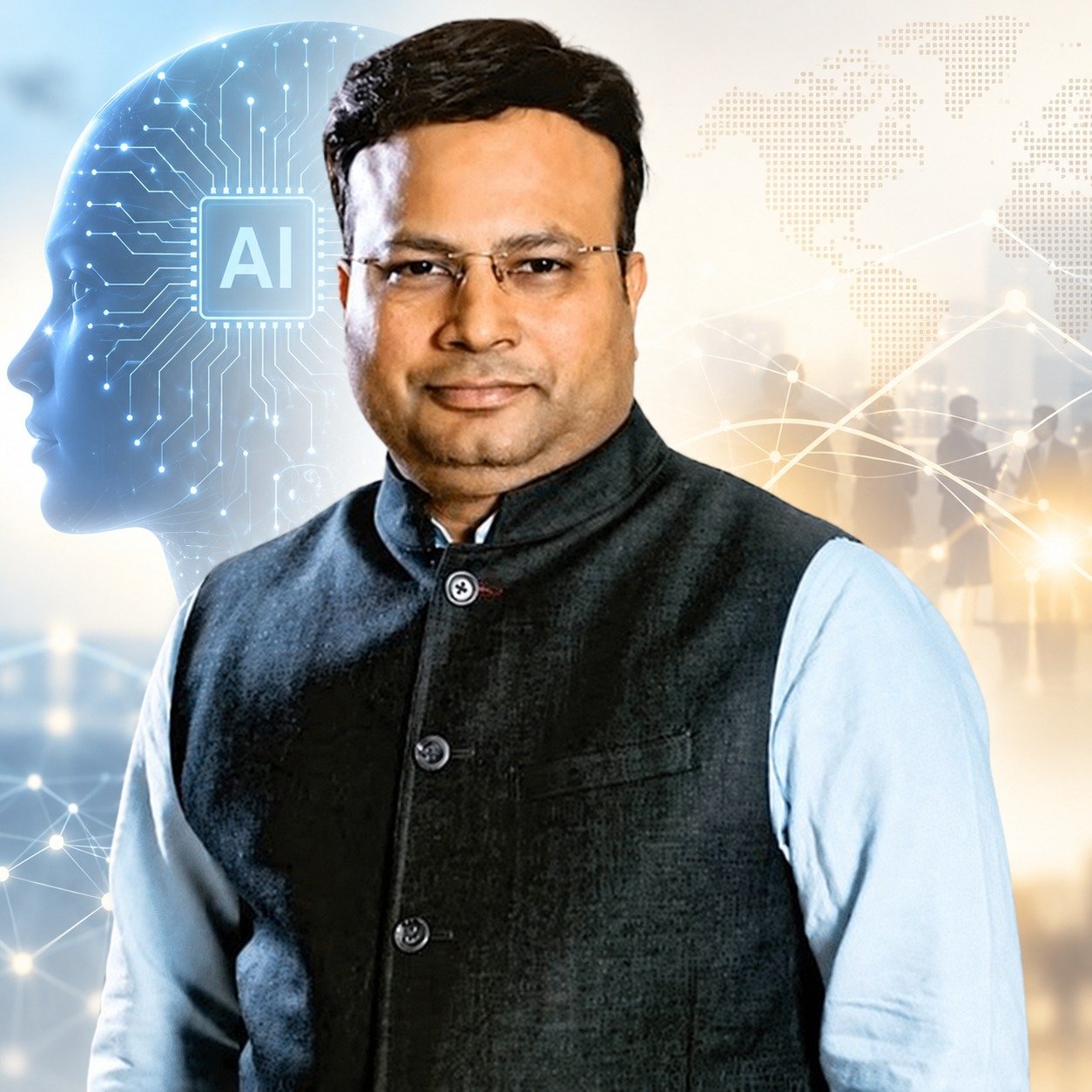
(The author, Dr. Sachin Gupta, is the Chancellor of Sanskriti University, Mathura.)
- HEPI & Kortext, Student Generative AI Survey 2026 (HEPI Report 199), and the 2024 and 2025 editions.
- Digital Education Council, AI in Higher Education Global Survey 2026 — 45,398 respondents, 35 countries.
- Stanford HAI, AI Index Report 2026.
- Gallup & Walton Family Foundation, Teaching for Tomorrow, June 2025.
- World Economic Forum, Future of Jobs Report 2025.
- ADP Research, People at Work 2026, as reported by IANS (May 2026).
- TechCrunch, "India has 100M weekly active ChatGPT users", February 2026.