
16-Year-Old Lakshmanan Meyyappan Becomes World’s Youngest Chartered Accountant VIEW NOW →
Choose wisely, live meaningfully — the alarming facts and what parents can do today
 A Phone Did Not Make the Decision — A Culture Did

When "I Need It" Quietly
Becomes "I Cannot Live Without It"

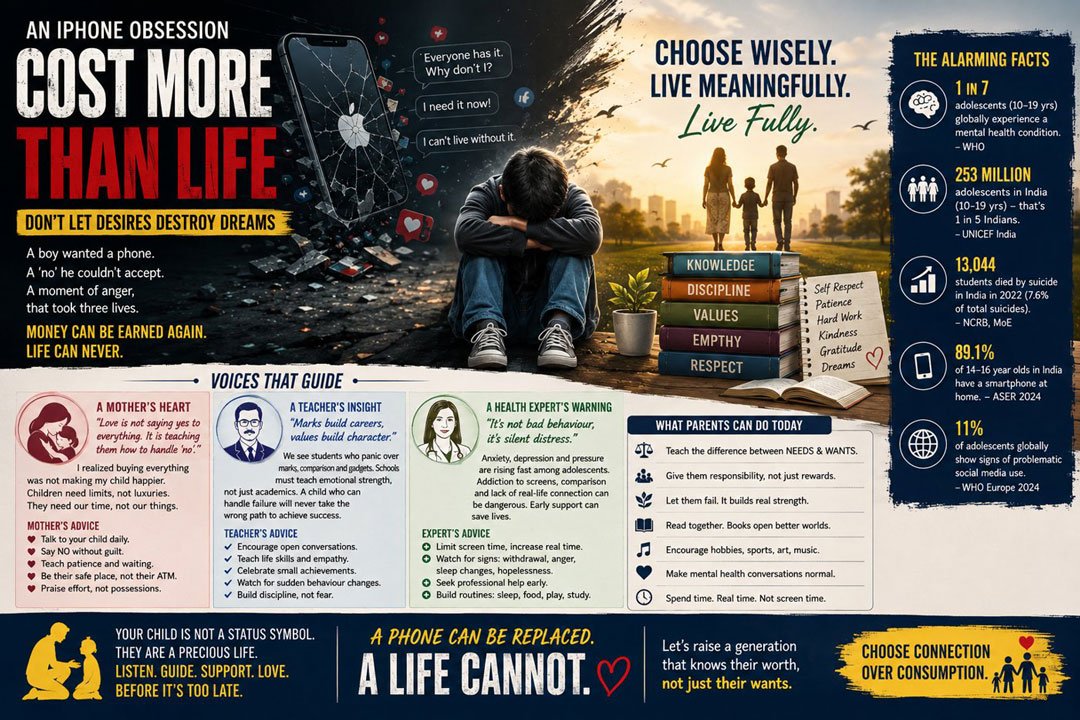
A recent tragedy in Chhatrapati Sambhajinagar, Maharashtra, took three lives in a family after a dispute reportedly linked to an expensive mobile phone. But the real question isn't whether a phone caused this. The real question is: why are some young people finding it increasingly difficult to cope with disappointment, comparison, financial limitations and the word "no"?

A Mother's Heart
"Buying Everything Was Not Making My Child Happier"
"Love is not saying yes to everything. It is teaching them how to handle 'no'." Every time a demand was met, the happiness lasted only a few days before the next desire appeared. Children need limits, not luxuries. They need our time, our attention — not our things.
Say no without guilt. Praise effort, not possessions. Be their safe place, not their ATM.
A Teacher's Insight
"Marks Build Careers, Values Build Character"
Teachers see students who panic over marks, comparison and gadgets long before parents do. Schools must teach emotional strength, not just academics — a child who can handle failure will never take the wrong path to achieve success.
Encourage open conversations. Celebrate small achievements. Watch for sudden behaviour changes.
A Health Expert's Warning
"It's Not Bad Behaviour, It's Silent Distress"
Anxiety, depression and pressure are rising fast among adolescents. Addiction to screens, comparison and a lack of real-life connection can be dangerous — and early support can save lives. This is a symptom, not simple defiance.
Limit screen time, increase real time. Watch for withdrawal, anger, sleep changes, hopelessness.
Parents, Look Inward Too
Are We the Consumer Culture We Later Blame Them For?
The biggest house. The best car. The newest phone. Children watch adults compete over brands — then hear "money isn't important." Children learn far more from what adults do than from what adults say.
If you want children to value education and discipline, those values must be visible at home first.
 The Alarming Facts

India Has the World's Largest Adolescent Population

🧠
1 in 7 Adolescents, Globally
The World Health Organization says roughly one in seven young people aged 10–19 experiences a mental health condition worldwide.
  • Depression, anxiety and behavioural disorders are leading causes of illness among adolescents
  • Suicide is the third leading cause of death among people aged 15–29
World Health Organization
👨‍👩‍👧
253 Million Adolescents in India
UNICEF India estimates India has about 253 million adolescents aged 10–19 — roughly one in every five Indians.
  • NCERT survey cited by UNICEF: 11% of students report anxiety, 14% extreme emotions, 43% mood swings
  • What happens to this generation shapes India's social and economic future
UNICEF India
📉
13,044 Student Suicides in 2022
7.6% of all recorded suicide deaths that year, per NCRB data cited by the Ministry of Education.
  • Academic pressure, financial stress, discrimination and stigma are named contributors
  • India's National Task Force has identified student distress as multi-dimensional
NCRB · Ministry of Education

How Connected Are India's Teens?

Adolescents aged 14–16 with a smartphone at home
Source: ASER 2024, via UNICEF India

Problematic Social-Media Use

Share of adolescents globally showing signs of struggling to control their use
Source: WHO Europe, 2024
 What Children Actually Say

The Words Every Parent
Has Heard at Least Once

Almost every parent has heard some version of these sentences. The word "need" is often used for something that is actually a want — and there is nothing wrong with wanting. The danger begins when a child is never taught the difference.

"Everyone has it. Why don't I?"
The comparison that never stops
"I need it now. I can't live without it."
When a want starts to feel like identity
"They have it. I don't."
Children see the finished picture — never the sacrifice behind it
 What a Screen Rarely Asks For

A Book Asks a Child to Stay, to Wait, to Imagine

Reading is not a magical cure for anxiety or addiction — a child in serious distress may need professional help. But reading, hobbies, sport, music, outdoor play and real conversation build a healthier childhood than a screen alone ever can. Perhaps the deeper problem isn't that children have stopped reading — it's that adults have stopped sitting with them long enough to make reading and reflection part of everyday life.

 Before the Crisis, Not After

What Parents Can Do Today

The most important intervention doesn't happen on a hospital bed — it happens at the dining table, when the child is eight, when the child is twelve, before the teenager enters college.

Teach Wants vs. Needs
Financial and emotional maturity start here
1
Food, education, safety and healthcare are needs. The latest phone is a want.
2
Be comfortable saying "No, we cannot afford it" without a 30-minute justification.
Give Responsibility, Let Them Wait
Delayed gratification is a life skill
1
Create a savings plan; let them contribute from an allowance or age-appropriate work.
2
Waiting changes the psychological relationship a child has with the object.
Don't Use Gadgets as Babysitters
Create technology-free family time
1
Dinner without phones. A walk without phones. A weekend without constant recording.
2
If the phone becomes the easiest way to keep a child quiet, it can become their emotional escape.
Know Their World
Friends, pressures, financial literacy
1
Know who their close friends are and what pressures they face — without spying.
2
Teach where money comes from, what an EMI means, and why adults sometimes postpone buying things.
Give Them Words for Feelings
Emotional vocabulary is protective
1
A child who can say "I feel left out" or "I am embarrassed" is easier to help than one who can only say "I hate everyone."
2
Normalise mental health conversations at home, the same way you'd discuss a physical illness.
Make Asking for Help a Strength
Trust can save lives
1
"If you make a mistake, tell us. If you're bullied, tell us." No automatic humiliation or punishment.
2
If behaviour changes suddenly — withdrawal, aggression, secrecy — ask questions and, if needed, seek professional help.
 CampusNewz's Call to Action

Choose Connection Over Consumption

Parents
Say no without guilt, when it's needed
Give responsibility, not just rewards
Let them fail — it builds real strength
Spend time. Real time. Not screen time
Your child is not a status symbol
Schools
Teach emotional strength, not just marks
Watch for sudden behaviour changes
Build discipline through routine, not fear
Create spaces to speak without fear
Train staff to spot early distress
Health Professionals
Treat behaviour as a symptom, not a verdict
Build routines: sleep, food, play, study
Watch for withdrawal, anger, hopelessness
Encourage early support, not crisis response
Support Tele-MANAS & Manodarpan access
Students
Remember a phone can be replaced — you can't
Disappointment is survivable
Your worth isn't measured in possessions
Talk to someone you trust when overwhelmed
Asking for help is strength, not weakness
Tech & Society
Protect children's digital vulnerabilities
Widen access to school mental-health support
Replace stigma with understanding
Stop measuring worth by possessions
Treat student wellbeing as a national priority
 Prevention Starts With Noticing

Signs No Parent Should Ignore

A dramatic behaviour should never automatically be dismissed as "bad behaviour." An adolescent's brain is still developing — powerful emotions can arrive before the maturity to regulate them does.

Emotional
  • Persistent sadness or irritability
  • Expressions of hopelessness
  • Fear of disappointing family
Physical
  • Sleep or appetite changes
  • Unexplained headaches, fatigue
  • Restlessness or irritability
Social
  • Withdrawing from family and friends
  • Losing interest in old hobbies
  • Secrecy around online activity
Behavioural
  • Anger or panic when screen time is limited
  • Reckless spending or borrowing
  • Extreme reactions to being told "no"
What They Say
  • "Everyone has it, why don't I?"
  • "I can't live without it"
  • "Nothing matters anymore"
Your child is not a status symbol. They are a precious life. A phone can be replaced. A pair of shoes can be replaced. Money can be earned again. A human life cannot. That is the lesson we must teach our children — before a desire becomes an obsession.
— A Message to Parents, CampusNewz Editorial Desk