
Beyond Headlines. The Complete Story.
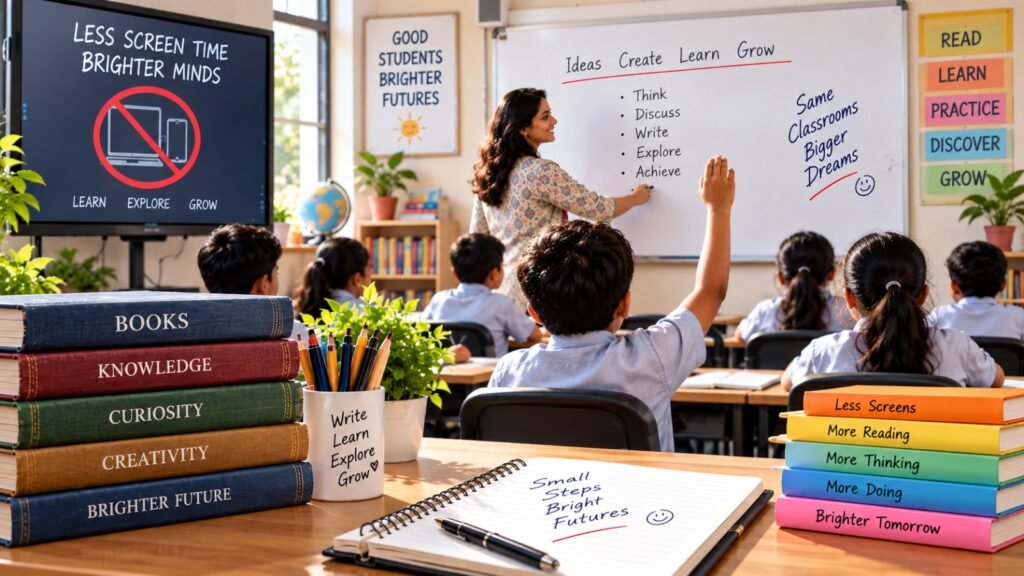
Schools are increasingly rethinking the role of technology in everyday classroom learning, with several institutions returning to notebooks, whiteboards, reading sessions and direct teacher-student interaction.
The shift comes amid growing concerns among parents and educators about excessive screen exposure among children. A recent directive has encouraged schools to limit the use of smartboards and other digital screens, particularly for younger students, and ensure that technology remains a supportive tool rather than the centre of classroom learning.
Instead of completely moving away from digital education, schools are adopting a balanced approach. Teachers are using whiteboards and marker pens more frequently, while students are being encouraged to write in physical notebooks and maintain school diaries. Some institutions are also reducing their dependence on digital platforms for routine homework instructions and communication with parents.
The renewed focus extends beyond traditional classroom tools. Schools are encouraging reading, storytelling, classroom discussions, role plays, art and craft, sports, yoga and hands-on activities. Such activities provide students with opportunities to interact, concentrate, communicate and learn beyond a screen.
Educators believe that reading physical books and engaging directly with teachers can help strengthen attention, discipline and meaningful classroom participation. Parents have also welcomed the change, particularly after the increased dependence on digital learning during the pandemic.
However, educators stress that technology itself is not the problem. Computers, digital resources and emerging AI tools are becoming an important part of modern education and can significantly enhance learning when used appropriately.
The real challenge is finding the right balance.
Books and screens, writing and digital learning, physical activity and technology can all have a place in education. The objective is to ensure that technology enhances the learning experience without replacing the human interaction, creativity and physical engagement that children need to grow.
CampusNewz Perspective: The future of education may not be about choosing between traditional and digital learning, but about knowing when to use which approach.