
Defence Stream
A life of Honour, Courage, and Patriotism — the Indian Armed Forces offer exciting, diverse, and technologically advanced careers to young men and women who aspire to defend the nation with pride, discipline, and unwavering dedication.
Overview
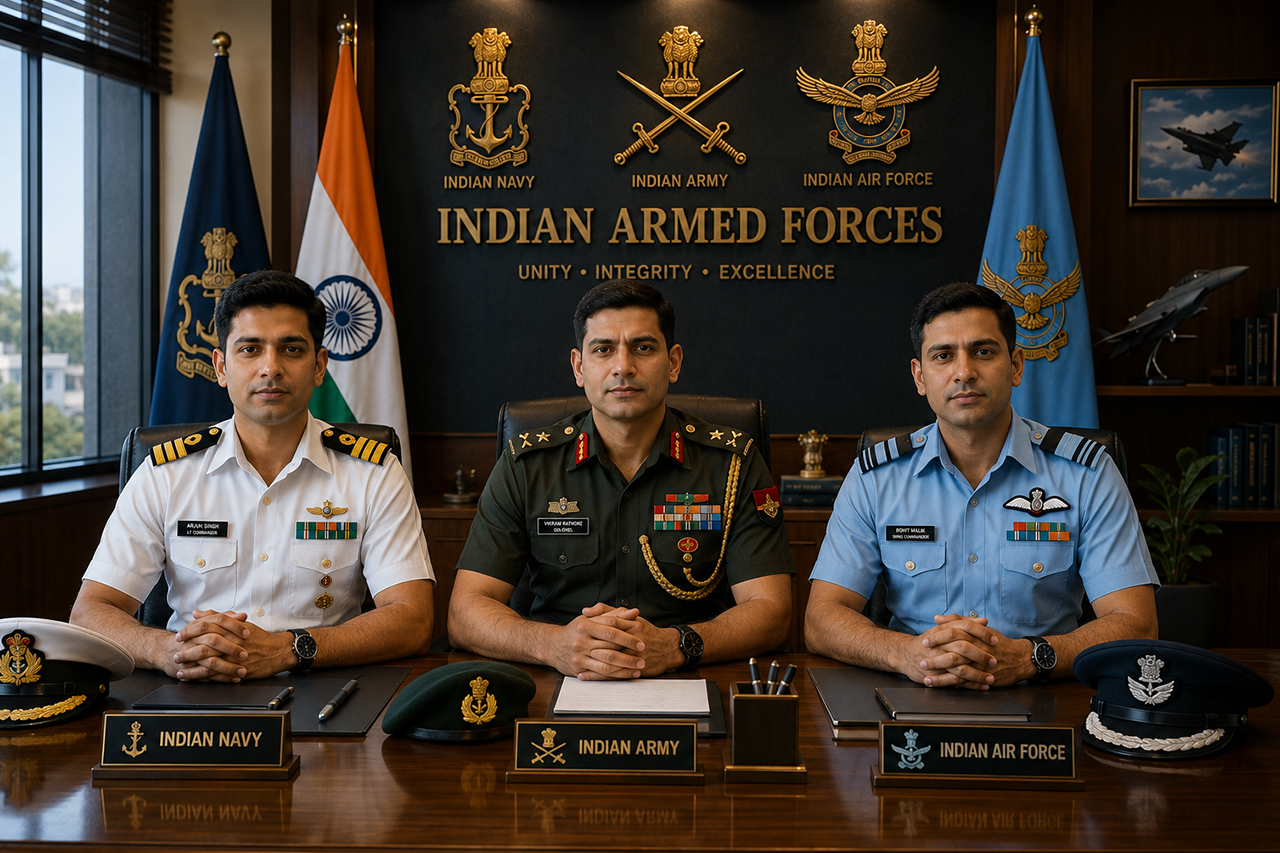
Choosing a career in defence is not just about a job — it is about dedication to the nation, upholding values of discipline and integrity, and leading a life of courage and leadership. The Indian Armed Forces — comprising the Indian Army, Indian Navy, and Indian Air Force — offer exciting and diverse career opportunities to young men and women who aspire to serve the nation with pride.
With evolving threats and advancements in technology, the defence sector is no longer limited to battlefield roles — it includes cyber warfare, intelligence, engineering, logistics, medical sciences, law, aviation, IT, and space operations. Defence careers combine physical endurance with intellectual challenge, leadership, and unmatched respect in society.
Students can enter Defence Services through various pathways: after Class 12 through NDA (National Defence Academy), after graduation through CDS (Combined Defence Services), or through Technical Entry Schemes (TES), AFCAT, and Short Service Commission (SSC). Beyond the armed forces, opportunities exist in DRDO, the Indian Coast Guard, and paramilitary forces across the country.
Defence services offer six distinct entry pathways — each suited to a different educational stage and career aspiration. From the prestigious NDA after Class 12 to DRDO research fellowships for science graduates, every pathway offers structured progression, honour, and national purpose.
India's most prestigious entry into defence — NDA is a tri-service academy in Khadakwasla, Pune. UPSC conducts NDA twice yearly; selected candidates undergo 3-year joint training followed by 1-year service-specific training at IMA Dehradun (Army), NAS Ezhimala (Navy), or AFA Dundigal (IAF). NDA alumni lead India's Armed Forces at the highest levels.
CDS is conducted by UPSC twice yearly for graduates — leading to IMA Dehradun (Army PC), OTA Chennai (Army SSC), NAS Ezhimala (Navy), and AFA Dundigal (IAF). CDS offers both Permanent Commission and Short Service Commission routes for men and women officers across all three services.
Engineering graduates and students can enter defence through TES (10+2 PCM direct entry into technical arms), UES (final-year engineering students recruited directly by Army), and AFCAT Technical (IAF entry for engineering graduates into Flying, Technical, Logistics, Administration, and Accounts branches).
SSC provides commissioned officer service for a fixed 10-year tenure (extendable to 14 years). At end of tenure, officers can apply for Permanent Commission based on merit and vacancies — or transition smoothly into civilian careers leveraging their defence leadership experience. Available for men and women in all three services.
DRDO employs scientists and engineers across 52 laboratories working on missiles, submarines, fighter aircraft, radar systems, and advanced materials. Entry via CEPTAM for technical posts and direct Scientist 'B' recruitment for engineering and science postgraduates. DRDO scientists can reach Distinguished Scientist rank (3-star equivalent).
The Indian Coast Guard recruits officers through CGEPT and direct entry schemes. Paramilitary forces — CRPF, BSF, CISF, ITBP, SSB, and NSG — offer Assistant Commandant posts through UPSC CAPF (AC) examination. These forces protect India's borders, internal security, critical infrastructure, and VIP personnel.
Defence services offer three distinct service streams — Army (ground operations, combat, and administration), Navy (maritime security and naval operations), and Air Force (air combat, transport, and technical operations) — each with its own specialisations, culture, and career trajectory.
Defence careers demand a unique combination of physical excellence, technical mastery, and exceptional leadership under pressure. The SSB interview is designed to assess 15 Officer Like Qualities (OLQs) — the personality traits that determine an officer's fitness to command.
Defence eligibility requirements vary by entry scheme — NDA after Class 12, CDS after graduation, and TES/AFCAT for specific technical and non-technical roles. Physical, medical, and psychological standards are equally important as academic qualifications for defence selection.
NDA and CDS are conducted by UPSC — India's premier examination body. AFCAT is conducted by the Indian Air Force. All three lead to a 5-day SSB (Services Selection Board) interview — the most comprehensive personality assessment in India's public sector selection process.
Conducted by UPSC twice yearly (April & September), NDA is India's most competitive after-12th defence entrance — the gateway to becoming an officer in all three services. Approximately 4–5 lakh students appear; only around 400 are finally selected per course after all stages.
The UPSC CDS examination is conducted twice yearly for graduates entering IMA (Army PC), OTA (Army SSC), NAS (Navy), and AFA (Air Force). CDS is the primary graduate-level entry into commissioned officer service in all three branches of the Indian Armed Forces.
Conducted by the Indian Air Force (IAF) twice yearly, AFCAT recruits men and women for Flying, Technical (Aeronautical Engineering), and Ground Duty (Administration, Logistics, Accounts, Education, Meteorology) branches through Short Service and Permanent Commission routes.
For defence aspirants targeting research or paramilitary careers, DRDO's CEPTAM and UPSC CAPF (AC) examination are key selection processes — offering stable, prestigious government careers in defence technology and internal security without the mandatory military physical and medical standards of the armed forces.
Defence services provide structured pay under the 7th Pay Commission Military Service Pay (MSP) structure — with additional allowances for field postings, high altitude, Siachen, flight pay, diving allowance, and sea pay that significantly enhance effective compensation beyond the basic pay figures.
Defence coaching institutes prepare students for NDA, CDS, AFCAT, and SSB interviews — covering written examination content, physical training guidance, and SSB personality test preparation. Lucknow, Delhi, Dehradun, and Chandigarh are the most concentrated clusters of defence coaching institutes in India.